


Choosing between term and whole life insurance is one of the biggest financial decisions you will make in your adult life and it is also one of the most misunderstood. The right policy can replace your income for decades, pay off a mortgage, fund your children’s future, and even build wealth you can borrow against. The wrong one can drain hundreds of dollars from your monthly budget for coverage you do not actually need.
At QuoteJoy, we help thousands of families compare life insurance options every month, and the term-vs-whole-life question comes up in nearly every conversation. This guide breaks down the real cost difference in 2026, the pros and cons of each policy type, and exactly which one fits your situation so you can buy with confidence instead of regret.
What Is Term Life Insurance?
Term life insurance is temporary coverage that pays a death benefit to your beneficiaries if you pass away during a fixed period, typically 10, 20, or 30 years. If you outlive the term, the coverage simply ends with no payout and no cash value built up. This is why term life is often called “pure life insurance†it does only one job, but it does that job at the lowest possible cost.
The premiums are level, meaning your monthly cost stays exactly the same for the entire term length. For a healthy 35-year-old non-smoker, a 20-year, $500,000 term policy averages just $30 per month in 2026. A 40-year-old buying the same coverage averages around $50 to $63 per month, depending on health class. This affordability is what makes term life the go-to choice for the vast majority of American families.
What Is Whole Life Insurance?
Whole life insurance is permanent coverage that lasts your entire life as long as premiums are paid. It combines a guaranteed death benefit with a built-in cash value component that grows tax-deferred at a fixed rate set by the insurer. You can borrow against this cash value, surrender the policy for the accumulated savings, or pass the full death benefit to your heirs tax-free.
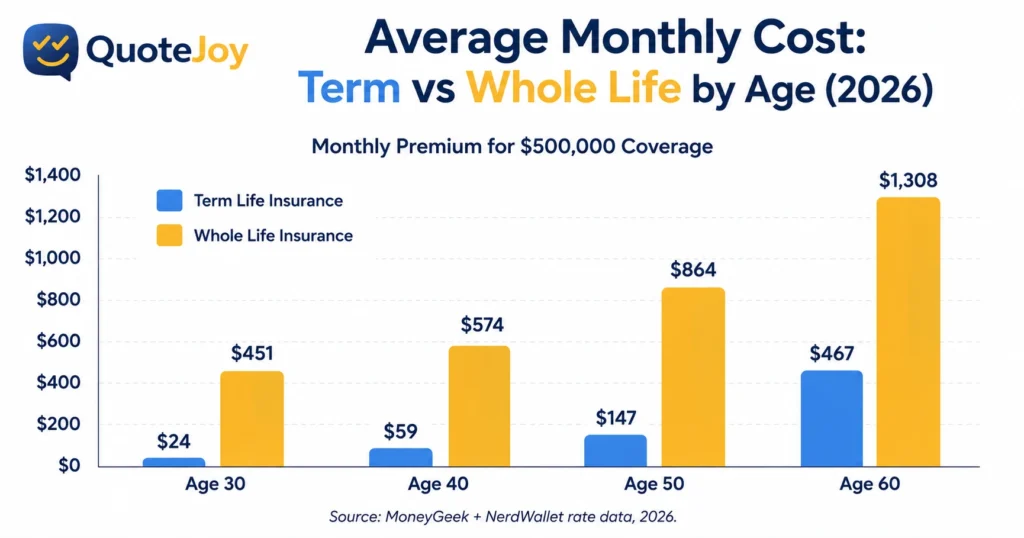
Whole life premiums are dramatically higher than term. A 40-year-old non-smoker pays an average of $574 per month for a $500,000 whole life policy in 2026 nearly ten times more than the equivalent term policy. The extra cost funds the lifetime guarantee, the cash value account, and potential annual dividends if the policy is issued by a mutual insurance company like MassMutual, Northwestern Mutual, or Guardian.
The Real Cost Difference in 2026
The price gap between term and whole life is the single most important factor in this decision. At age 35, a healthy non-smoker can buy $500,000 of 20-year term coverage for about $30 per month, while the same person would pay roughly $500 per month for a comparable whole life policy. At age 40, the gap widens in dollar terms: $59 per month for term versus $574 per month for whole life. At age 60, universal life and whole life both stretch past $900 to $1,400 per month.
Over a 20-year period, the term policyholder spends roughly $7,200 total on premiums, while the whole life policyholder spends over $138,000. The whole life buyer ends up with cash value and lifetime coverage, but the term buyer keeps the $130,000 difference which is exactly why financial advisors often recommend the strategy of “buy term and invest the difference.â€
Pros and Cons of Term Life Insurance
Term life is the most affordable life insurance product on the market, which makes it ideal for replacing your income during your working years. You can typically buy 10 to 15 times more coverage with term than with whole life for the same monthly premium. This means a young parent earning $80,000 per year can lock in a $1 million death benefit for less than the cost of a streaming subscription bundle.
The downside is that coverage is temporary. If you outlive your 20- or 30-year term, the policy expires with no return of premium and no cash value. Renewing afterward requires a new application at older-age rates, and any health issues that developed during the term can push premiums sharply higher or even make you uninsurable. Term life also offers no investment or wealth-transfer benefit, so it is not the right tool for estate-planning or high-net-worth strategies.
Pros and Cons of Whole Life Insurance
Whole life insurance guarantees three things at once: a fixed premium that never increases, a death benefit that never expires, and a cash value account that grows at a guaranteed rate. Participating policies from mutual insurers can also pay annual dividends, boosting cash value or reducing premiums over time. This combination makes whole life genuinely useful for estate planning, lifetime gifting strategies, and households with a permanent dependent such as a special-needs child.
The biggest drawback is cost. Whole life runs 10 to 22 times more expensive than term for the same death benefit, and during the first five to ten years almost none of your premium actually goes toward cash value — most of it covers carrier overhead and agent commissions. The guaranteed growth rate is also far lower than long-term stock market returns, so using whole life as your primary investment vehicle comes with a steep opportunity cost.
Which One Should You Buy?
For roughly 90% of buyers, term life insurance is the right choice. It delivers maximum income protection during the years your family needs it most while you are paying down a mortgage, raising children, or building retirement savings. Once those obligations are gone and you are self-insured through accumulated wealth, lifetime coverage is no longer financially necessary. If you are in this group, head over to our life insurance comparison page to lock in a 20- or 30-year policy at the best available rate.
Whole life insurance makes sense in three specific situations: you have a lifelong dependent who will always require financial support, you have already maxed out tax-advantaged retirement accounts and want another tax-deferred bucket, or you are using life insurance as part of a deliberate estate-planning or wealth-transfer strategy. If you are also reviewing auto insurance or home insurance coverage, bundling life insurance with these other policies can unlock additional multi-policy discounts of 10–25%.
The Bottom Line
Term vs whole life insurance is rarely a tie. Term wins on affordability, simplicity, and pure income replacement. Whole life wins on permanence, cash value, and estate planning. For most working-age adults raising a family, term life is the smart, math-backed choice — buy enough coverage to last until your kids are independent, invest the savings elsewhere, and revisit the decision every five years. Ready to see your real numbers? Get your free QuoteJoy life insurance quote now and compare term and whole life side by side in under 90 seconds.
Frequently Asked Questions (FAQs)
Term life insurance is better for most people because it provides 10–15 times more coverage than whole life for the same monthly premium. Whole life is only better if you need permanent coverage for estate planning or a lifelong dependent.
Whole life insurance typically costs 10 to 22 times more than term life for the same death benefit. A 40-year-old non-smoker pays around $574 per month for $500,000 of whole life versus just $59 per month for a 20-year term policy.
No, you cannot cash out a term life insurance policy because it has no cash value component. Term life only pays a death benefit if you pass away during the policy term — if you outlive it, the policy simply expires.
When term life insurance expires, your coverage ends with no payout and no refund of premiums. You can buy a new policy at older-age rates, convert to permanent coverage if your policy includes a conversion rider, or go without coverage if you are already self-insured.
Yes, for most working-age buyers, buying term and investing the difference produces better long-term wealth than whole life. Investing the $500+/month premium gap in a diversified index fund typically outperforms whole life cash value growth over 20+ years.