

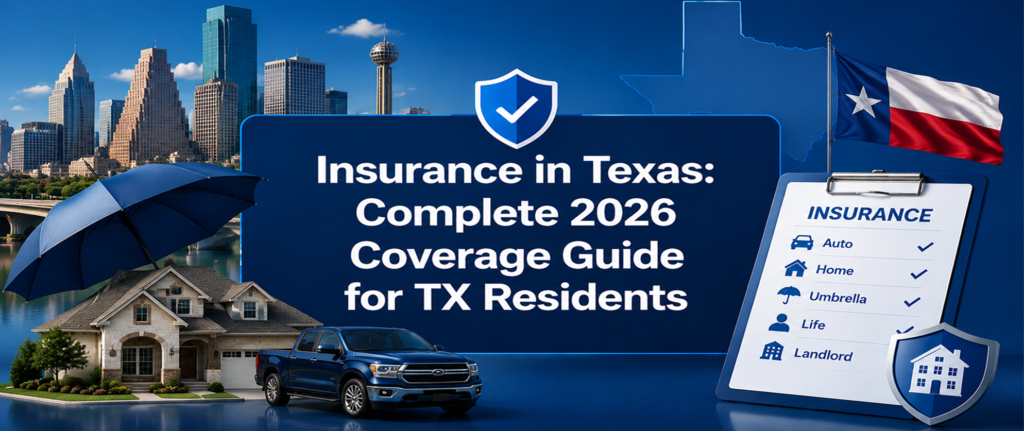
Insurance in Texas isn’t like insurance anywhere else in the United States. From Hurricane Harvey-class storms on the Gulf Coast, to the country’s worst hail damage in the DFW and Austin metros, to the highest uninsured driver rates in the U.S., Texas drivers, homeowners, landlords, and families face a unique mix of risks — and a unique set of rules from the Texas Department of Insurance (TDI). The good news: with the right coverage, all of these risks become manageable, and Texas residents have access to one of the most competitive insurance markets in America.
Whether you’re a Houston homeowner worried about flood risk, a Dallas driver shopping cheaper auto coverage, an Austin parent buying life insurance for the first time, a San Antonio investor protecting a rental, or a Texas insurance agent looking for high-converting leads, QuoteJoy connects you with top U.S. carriers writing in Texas. This page is your complete guide to insurance in Texas in 2026 — the state minimums, the typical costs, the risks specific to TX, and the coverage options for each of the six services we offer.
Why insurance in Texas is different from the rest of the USA
Texas has some of the most insurance-relevant statistics in the United States, and they shape every policy written in the state:
- Hail capital of America. Texas leads the U.S. in hail damage claims, with the DFW, Austin, and San Antonio metros taking the brunt. Annual hail losses regularly exceed $1 billion across the state.
- Major hurricane exposure. The Gulf Coast — Houston, Galveston, Corpus Christi, Beaumont — sits in active hurricane territory. Hurricane Harvey alone caused over $125 billion in damage across Texas in 2017.
- Tornado Alley reach. The Texas Panhandle and North Texas regularly see severe storms and tornadoes during spring.
- High uninsured driver rate. Roughly 14% of Texas drivers are uninsured — above the U.S. average — making uninsured motorist coverage especially important here.
- Credit-based insurance pricing. TX allows insurers to use credit-based insurance scores in pricing auto and home policies, which can swing premiums dramatically.
- At-fault tort system. Texas is an at-fault state, not a no-fault state. The driver who caused the accident (or their insurer) pays.
- No state-mandated PIP. Personal Injury Protection (PIP) is optional in TX; insurers must offer it but Texans can decline in writing.
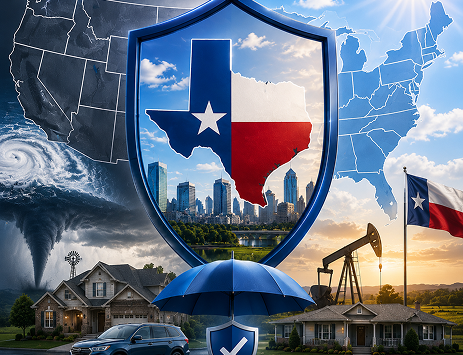
This combination — hail, hurricanes, tornadoes, high uninsured rates, and credit-based pricing — makes shopping multiple carriers especially valuable in Texas. Two identical TX households can see premium differences of $1,000 or more per year between carriers.
Coverage Services
1. Auto / Car Insurance in Texas
Texas auto insurance is required for every driver registering a vehicle in the state, and TDI enforces strict minimum liability limits known as 30/60/25:
Coverage type | Texas minimum | What it means |
|---|---|---|
Bodily injury per person | $30,000 | Maximum paid for one injured person |
Bodily injury per accident | $60,000 | Maximum paid for all injuries in one accident |
Property damage liability | $25,000 | Maximum paid for damage to other property |
These TX minimums are dangerously low for any serious accident — a single hospital stay in Houston, Dallas, or Austin can easily exceed $30,000. Most U.S. financial advisors recommend Texas drivers carry at least 100/300/100 ($100K bodily injury per person / $300K per accident / $100K property damage), regardless of state minimums.
Typical Texas auto insurance costs
Average annual auto insurance in Texas runs roughly $1,800 to $2,400 for full coverage and $650 to $900 for liability-only — a bit higher than the U.S. average because of high hail and theft losses. Drivers in Houston, Dallas-Fort Worth, and San Antonio metros typically pay more than rural Texas drivers. Adding a teen driver, having a poor credit-based insurance score, or filing recent claims can push premiums significantly higher.
Compare auto insurance quotes in Texas and see what coverage from top U.S. carriers actually costs for your ZIP code, driving record, and credit profile. For a deeper breakdown of what “full coverage” includes, see our guide on what does full coverage car insurance cover.
2. Home Insurance in Texas
Home insurance in Texas is one of the most important purchases an American homeowner makes — and one of the most expensive, because of the state’s catastrophe exposure. Texas homeowners insurance is regulated by TDI and typically written as an HO-3 policy (open-perils), with specific Texas-only considerations:
Wind / hail deductibles. Most Texas home policies carry a separate percentage deductible (often 1–2% of dwelling coverage) specifically for wind and hail claims, which are extremely common in TX.
Hurricane deductibles. Gulf Coast Texas properties (Houston, Galveston, Corpus Christi, Beaumont) typically have a separate named-storm or hurricane deductible, often 2–5% of dwelling coverage.
Flood is excluded. Like every U.S. state, standard Texas homeowners policies do NOT cover flood damage from outside the home. Coastal and low-lying Texas properties need separate NFIP (FEMA) or private flood coverage.
Foundation movement risk. Texas clay soils cause foundation issues; many TX policies include limited foundation coverage but with significant restrictions.
Typical Texas home insurance costs
Texas home insurance averages around $2,200 to $3,500 per year for a typical single-family home — well above the U.S. national average of about $1,800. Coastal TX properties can easily run $4,000 to $8,000+ when including hurricane and wind/hail premiums. Houston, Galveston, and Corpus Christi homes face the highest premiums; inland Texas cities like Austin, San Antonio, and DFW pay less, though hail-prone DFW carries its own premium load.
If you own an older Texas home with original wiring, plumbing, or roof, see our guide on home insurance for older homes for what to look for. For roof claims specifically (extremely common in TX due to hail), see does home insurance cover roof replacement. Ready to shop? Compare Texas home insurance quotes here.
3. Life Insurance in Texas
Texas has the second-largest life insurance market in the United States after California, with strong demand driven by Texas’s young population (median age around 35), high homeownership rates, and growing family households in the Austin, Houston, and DFW metros. Life insurance in Texas works the same way as anywhere else in the U.S. — you pay a premium, the insurer pays your beneficiaries a tax-free death benefit — but Texans have a few specific factors worth noting:
State-level consumer protections. TDI requires a 10-day free-look period on most policies, during which a Texas applicant can cancel for a full premium refund.
Group life through major Texas employers — oil & gas, healthcare, tech, and military bases — covers many Texans, but rarely at the 10–12× income most planners recommend.
Texas is a community property state, which affects how life insurance proceeds and beneficiaries interact with spousal property law. Naming beneficiaries carefully matters more here than in most U.S. states.
Typical Texas life insurance costs
For a healthy 35-year-old Texas non-smoker, $500,000 of 20-year term life insurance typically costs around $28–$45 per month — in line with U.S. averages because life insurance pricing is largely health-based, not state-based. Smokers, applicants with health conditions, and older buyers pay more. For deeper sizing guidance, see how much life insurance do I need; for first-time buyers, how does life insurance work is the foundational explainer.
Compare Texas life insurance quotes and see real coverage options from top U.S. carriers. Specific situations are covered in life insurance for parents, for smokers, for seniors, and no-medical-exam options.
4. Landlord Insurance in Texas
Texas is one of the hottest rental property markets in the United States. Austin, Houston, San Antonio, DFW, and college towns like College Station and Lubbock all have strong rental demand, and Texas property investors have grown the state’s rental footprint by hundreds of thousands of units in the past decade. If you rent out any property in Texas, you almost certainly need landlord insurance — not a homeowners policy.
Texas landlord insurance is most commonly written as a DP-3 (dwelling fire) policy, which covers:
Dwelling structure at replacement cost
Landlord liability — essential in TX because of strong tenant lawsuit activity
Fair rental value (loss of rent for up to 12 months)
Hail / wind / hurricane with separate deductibles as on homeowners coverage
Tenant damage — sudden and accidental yes; intentional usually requires an endorsement
Typical Texas landlord insurance costs
Texas landlord insurance averages roughly $1,800 to $3,000 per year for a typical single-family rental, with coastal properties and older homes running higher. Premiums are typically 15–25% higher than equivalent homeowners coverage. The good news: landlord insurance premiums are deductible on Schedule E of your federal tax return as an ordinary rental business expense.
For more detail, see our guides on landlord insurance cost, best landlord insurance, and what landlord insurance covers. If you’re switching from a homeowners policy after starting to rent your property, landlord insurance vs homeowners insurance walks through the exact change. Ready to shop? Get Texas landlord insurance quotes here.
5. Umbrella Insurance in Texas
Texas’s strong economy has created a lot of high-net-worth households — the Houston, Dallas, and Austin metros are home to thousands of Texans with assets worth protecting beyond standard auto and home liability limits. Umbrella insurance is the U.S. coverage that fills this gap, adding $1 million to $5 million (or more) of extra liability protection on top of your existing auto and home policies.
Texas umbrella insurance is particularly valuable because:
TX has a strong litigation environment. Personal-injury and slip-and-fall lawsuits are common in Texas, and judgments can easily exceed the standard 30/60/25 minimums or even higher liability limits.
Texas has high vehicle traffic and accident rates in Houston, Dallas-Fort Worth, San Antonio, and Austin metros.
Texas allows wage garnishment for certain civil judgments, which is exactly what umbrella coverage protects against.
Pool / trampoline / dog ownership — common in Texas suburbs and exactly the risks umbrella coverage is designed for.
Typical Texas umbrella insurance costs
Umbrella insurance is one of the best values in U.S. personal insurance. The first $1 million typically costs around $150 to $300 per year for Texas households, with each additional $1 million often adding only $75 to $100. For full sizing guidance, see how much umbrella insurance do I need; for pricing detail, umbrella insurance cost; and what is umbrella insurance for the foundational explainer. Compare Texas umbrella quotes here.
6. Insurance Leads for Texas Agents
Texas is the second-largest U.S. insurance agent market — only California has more licensed producers. With ~50,000+ licensed Texas agents competing in auto, home, life, and commercial lines, high-quality leads are the difference between scaling an agency and burning marketing dollars. QuoteJoy partners with Texas insurance agents and agencies looking for exclusive, high-intent U.S. leads across all major coverage types.
Texas-specific advantages for insurance agents working with QuoteJoy:
High population density in major TX metros creates consistent lead flow (Houston, DFW, San Antonio, Austin).
Diverse vertical opportunities — auto leads in DFW, home/wind leads on the Gulf Coast, life leads in fast-growing Austin and Frisco, landlord leads from the booming rental market.
High average premiums mean higher commissions per converted lead.
Strong agency density in Houston, Dallas, San Antonio, Austin, and Fort Worth allows fast lead routing and competitive response times.
Whether you’re a one-person Texas agency or a multi-office group, explore QuoteJoy’s insurance lead programs for Texas agents and see what high-intent TX leads cost and convert at.
Compare auto insurance quotes in Texas and see what coverage from top U.S. carriers actually costs for your GA ZIP code, driving record, and credit profile. For a deeper breakdown of what “full coverage” actually includes, see our guide on what does full coverage car insurance cover. If your credit is affecting your rate, see car insurance for bad credit.
Average insurance costs in Texas vs national U.S. average
Coverage type | Texas annual average | U.S. national average | Difference |
|---|---|---|---|
Auto (full coverage) | $1,800 – $2,400 | $1,700 – $2,100 | Slightly above |
Auto (liability only) | $650 – $900 | $600 – $800 | Slightly above |
Home (single family) | $2,200 – $3,500 | $1,500 – $1,900 | Well above |
Home (Gulf Coast) | $4,000 – $8,000+ | — | Significantly above |
Life (term, age 35, $500K) | $28 – $45/month | $28 – $45/month | Same |
Landlord (single family) | $1,800 – $3,000 | $1,500 – $2,500 | Above |
Umbrella ($1M) | $150 – $300 | $150 – $300 | Same |
Texas premiums run above the U.S. average mainly because of hail, wind, and hurricane exposure on the property side. Auto premiums sit slightly above the U.S. average due to high uninsured driver rates and urban accident frequency. Life and umbrella are roughly the same as anywhere in the country because pricing is driven by health and personal liability factors, not state property risk.
State-specific risks every Texas resident should know
Hurricanes and tropical storms (Gulf Coast)
Houston, Galveston, Corpus Christi, Beaumont, and the entire Texas coast face hurricane and tropical storm risk every June–November. Hurricane Harvey alone caused over $125 billion in U.S. damage in 2017. Standard Texas homeowners insurance does NOT cover flood; coastal Texans almost universally need separate NFIP or private flood policies.
Hail (DFW, Austin, San Antonio, Panhandle)
Texas leads the United States in hail damage claims by a wide margin. North Texas (DFW), Central Texas (Austin), and the Panhandle see severe spring hail seasons that regularly cause $500 million–$1 billion in single-storm losses. Most Texas home and auto policies carry separate hail deductibles.
Tornadoes (Panhandle, North Texas)
The Texas Panhandle and North Texas sit at the southern edge of Tornado Alley. Major tornado outbreaks have hit DFW suburbs, Wichita Falls, and the Panhandle multiple times in recent years.
Wildfires (West and Central Texas)
Less famous than California, but Texas wildfire seasons can be severe, especially in the Hill Country, West Texas, and during droughts. The 2024 Smokehouse Creek Fire in the Panhandle burned over 1 million acres — the largest in Texas history.
Theft and vehicle crime (Houston, DFW)
Houston and Dallas-Fort Worth both rank in the top 20 U.S. metros for vehicle theft, including catalytic converter theft. Comprehensive auto coverage is especially valuable in urban Texas. See does car insurance cover catalytic converter theft for the coverage specifics.
Major Texas cities QuoteJoy serves
QuoteJoy connects residents and agents across every major Texas market with top U.S. carriers: Houston, Dallas, San Antonio, Austin, Fort Worth, El Paso, Arlington, Corpus Christi, Plano, Lubbock, Garland, Irving, Frisco, McKinney, Pasadena, Grand Prairie, Brownsville, McAllen, Mesquite, Killeen, Carrollton, Midland, Waco, Denton, Abilene, Beaumont, College Station, Round Rock, The Woodlands, Tyler, Lewisville, Pearland, Sugar Land, League City, Wichita Falls, Allen, Conroe, Bryan, Edinburg, Galveston, Mission, and surrounding Texas communities. No matter which Texas ZIP code you’re in, we can match you with carriers writing competitive coverage in your area.
Frequently asked questions about insurance in Texas
What is the minimum car insurance required in Texas?
What is the minimum car insurance required in Texas?
Texas requires every driver to carry at least 30/60/25 liability coverage — $30,000 in bodily injury liability per person, $60,000 per accident, and $25,000 in property damage liability. The Texas Department of Insurance (TDI) enforces these minimums, but they’re dangerously low for a serious accident. Most TX drivers should carry significantly higher limits, ideally 100/300/100 or above.
Why is home insurance so expensive in Texas?
Why is home insurance so expensive in Texas?
Texas home insurance costs more than the U.S. average mainly because of the state’s catastrophe exposure — the most hail damage of any U.S. state, major hurricane risk on the Gulf Coast, tornado activity in North Texas and the Panhandle, and rising wildfire losses in West Texas. Most Texas home policies also carry separate wind/hail and hurricane deductibles that make claim payouts smaller.
Do Texas drivers need uninsured motorist (UM) coverage?
Do Texas drivers need uninsured motorist (UM) coverage?
Texas insurers are required to OFFER uninsured/underinsured motorist coverage, but Texans can decline it in writing. Given that roughly 14% of Texas drivers are uninsured, UM/UIM is highly recommended on every TX auto policy — declining it leaves you exposed when an uninsured driver hits you.
Does Texas allow credit-based insurance scoring?
Does Texas allow credit-based insurance scoring?
Yes — Texas allows insurers to use credit-based insurance scores in pricing auto and home policies. A poor TX insurance score can raise your premium significantly compared to a strong one. If your credit is affecting your auto rate, see our guide on car insurance for bad credit for U.S. carriers that weigh credit less heavily.
Is flood insurance required in Texas?
Is flood insurance required in Texas?
Texas does not legally mandate flood insurance for all homeowners, but lenders require it for properties in FEMA-designated Special Flood Hazard Areas (typically Gulf Coast and floodplain properties). Standard Texas homeowners insurance does NOT cover flood damage — separate NFIP or private flood coverage is needed regardless of whether the lender requires it.
How much umbrella insurance do Texas homeowners typically buy?
How much umbrella insurance do Texas homeowners typically buy?
Most Texas households start with a $1 million umbrella policy at around $150–$300/year. Higher-net-worth Texans, families with teen drivers, owners of pools or rental properties, and high earners often carry $2 million to $5 million. The rule of thumb is to cover at least your full net worth plus future income exposure.
Can Texas insurance agents buy leads from QuoteJoy?
Can Texas insurance agents buy leads from QuoteJoy?
Yes. QuoteJoy partners with Texas insurance agencies and independent agents looking for high-intent, exclusive U.S. leads across auto, home, life, landlord, and umbrella coverage. Visit our insurance leads page for details on Texas lead programs, pricing, and conversion expectations.
The bottom line on insurance in Texas
Texas insurance is shaped by the state’s unique risk profile — the most hail damage in the United States, major hurricane and flood exposure on the Gulf Coast, tornado activity in North Texas, high uninsured driver rates, and a litigation-friendly environment. The right insurance approach for any Texas resident usually means: higher-than-minimum auto liability limits, replacement-cost home coverage with separate flood (NFIP), a landlord policy for any rental property, an umbrella for asset protection, and life insurance sized to your family’s actual financial needs.
Because Texas premiums vary so dramatically between carriers — sometimes $1,000+ per year on identical coverage — the single most important thing any Texas resident can do is compare multiple top U.S. carriers before committing. That’s exactly what QuoteJoy is built for.
Ready to shop your Texas coverage? Compare auto, home, life, landlord, and umbrella insurance quotes from top U.S. carriers writing in TX. Texas insurance agents: explore our lead programs here. Questions? Contact our team for help choosing the right Texas coverage mix.