


Umbrella insurance is the most underused policy in personal finance and it is also one of the cheapest. After thirteen years writing policies for households at every income level, I can tell you the price gap between “what people think umbrella insurance costs” and what it actually costs is enormous. Most assume a $1 million policy runs hundreds of dollars per month. The real number for a typical household in 2026 is closer to $15–$25 per month.
This guide gives you the actual 2026 rates by coverage amount, the eight factors that move your premium up or down, and the math for figuring out where your sweet spot sits. No padded ranges, no “contact us for a quote” deflections real numbers a household can plan around.
How Umbrella Insurance Pricing Works
Umbrella insurance is excess liability coverage. It sits on top of the liability limits in your auto, homeowners, and (if applicable) landlord policies, and kicks in once those underlying limits are exhausted. Because most claims never reach the umbrella layer, carriers can price these policies at a fraction of what equivalent liability coverage costs through your auto or home policy.
Three pricing rules drive almost all premium variation:
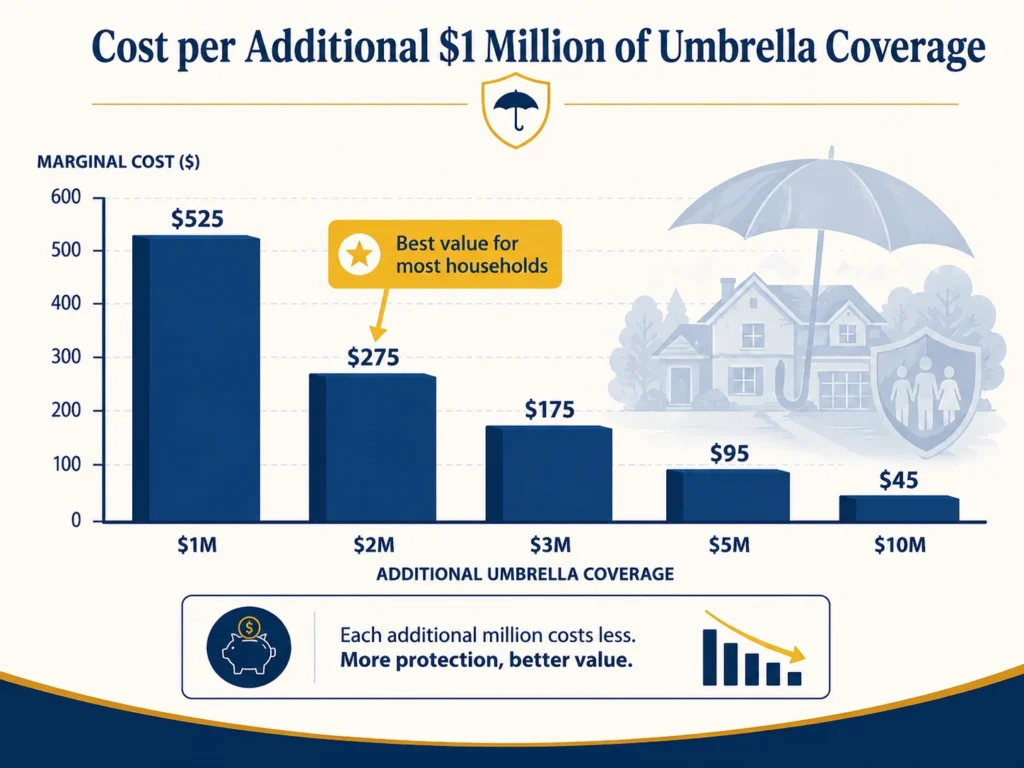
- The first $1 million of umbrella coverage is the most expensive on a per-dollar basis. Each additional $1 million typically costs only $75–$125 more per year.
- Premiums scale with the number of cars, drivers, homes, and rental properties you own — not directly with income or net worth.
- Most carriers require you to carry minimum liability limits on your underlying policies (usually $250,000 on auto, $300,000 on home) before they will issue an umbrella policy.
Real 2026 Umbrella Insurance Rates
These are average annual premiums for a personal umbrella policy in 2026, based on the rate filings of nine major U.S. carriers. The figures assume a household with two cars, one home, no rental properties, no teen drivers, no swimming pool, and a clean driving and claims history.
| Coverage Amount | Annual Premium | Monthly Premium | Cost per $1M of Coverage |
|---|---|---|---|
| $1,000,000 | $180 – $300 | $15 – $25 | $240 |
| $2,000,000 | $280 – $420 | $23 – $35 | $175 per million |
| $3,000,000 | $370 – $540 | $31 – $45 | $152 per million |
| $5,000,000 | $580 – $820 | $48 – $68 | $140 per million |
| $10,000,000 | $1,200 – $1,800 | $100 – $150 | $150 per million |
The diminishing per-dollar cost is the most important thing on that table. Going from $1 million to $2 million typically adds only about $100 per year, but doubles your protection. Going from $2 million to $3 million adds about another $100 for another million in coverage. This is why most insurance professionals carry at least $2 million on themselves the marginal cost is small enough that the math almost always favors more coverage.
Eight Factors That Move Your Umbrella Premium
Two households shopping the same $1 million policy can pay $180 and $620 respectively. The variation comes from eight pricing factors that every carrier weighs differently. Knowing which apply to you is the difference between buying smart and overpaying.
1. Number of vehicles and drivers
The single biggest factor for most households. Each additional vehicle adds roughly $30–$50 per year to the umbrella premium. Each additional driver under 25 can add $80–$200 per year, because young-driver risk is the most common path to claims that exhaust auto liability and reach the umbrella layer.
2. Number of properties
Each home or rental property on the policy adds $40–$100 per year. Rental properties cost more than primary residences because they introduce tenant injury exposure on top of premises liability.
3. Recreational property and toys
Boats over 25 feet, jet skis, ATVs, snowmobiles, motorcycles, and trailers each add $50–$150 per year, depending on horsepower and usage. Some carriers exclude these entirely from a personal umbrella and require a separate marine or motorcycle umbrella.
4. Pool, hot tub, or trampoline
These “attractive nuisances” raise premiums by $50–$150 per year and can disqualify you from some carriers entirely. Carriers underwriting pools usually require specific safety features — pool fencing, gates with self-latching mechanisms, and depth markings.
5. Dog ownership and breed
Many carriers either exclude or surcharge specific dog breeds with bite-claim history. The exact list varies, but commonly includes Pit Bulls, Rottweilers, Doberman Pinschers, German Shepherds, and several others. A dog bite claim is one of the most common reasons umbrella coverage gets triggered.
6. Public profile and occupation
Public-facing professionals elected officials, executives, professional athletes, social media personalities with significant followings face higher defamation and slander exposure. Some carriers surcharge for this; others exclude defamation entirely without an endorsement.
If your work puts you in front of audiences, our umbrella insurance guide covers what to look for in defamation and personal injury coverage endorsements.
7. Driving and claims history
DUIs, multiple speeding tickets in three years, and any prior umbrella claim raise premiums sharply or cause carriers to decline coverage entirely. A clean five-year history is the baseline for the rates shown in the table above.
8. State of residence
Premiums in litigious states (California, New York, Florida, New Jersey, Illinois) run 15–35% higher than in less litigious states (Idaho, Wyoming, Iowa, Vermont). This reflects average jury verdict sizes and the frequency of large liability claims by state.
How Much Umbrella Coverage Do You Need?
The textbook answer is to carry umbrella coverage equal to your total net worth, including retirement accounts, home equity, and future earnings. The practical answer in 2026 is that anyone with a household net worth above $250,000, two or more cars, or any teen drivers should be carrying at least $1 million and most should consider $2 million given the marginal cost.
The reason involves how lawsuits actually work. A judgment that exceeds your auto or home liability limits can come after your savings, your home equity, and a portion of your future wages. Without umbrella coverage, a single at-fault accident causing serious injury to another driver can produce a $1.5–$2.5 million claim and the underlying $300,000 auto liability limit is gone in the first 20 minutes of the negotiation.
Where Umbrella Insurance Saves Money in 2026
Three bundling moves consistently lower umbrella premiums. First, buy the umbrella through the same carrier as your auto and home policies most carriers offer a 5–10% multi-policy discount on the umbrella. Second, if you own rental properties, layer them into a single umbrella rather than buying separate ones for each. Third, accept a slightly higher underlying liability limit on auto and home if your carrier requires it sometimes the umbrella premium drops more than the underlying premium rises. For more on stacking discounts, see our home and auto bundle discount guide.
When Umbrella Insurance Is Probably Not Worth It
Honesty requires a clear paragraph here too. Umbrella insurance is not the right purchase for everyone. If you rent rather than own, have minimal savings, drive an older car with low usage, and have no teen drivers or recreational risks in the household, the underlying $250,000 auto and renters liability limits may already cover your realistic exposure. The decision turns on what you would lose in a worst-case lawsuit if the answer is genuinely “not much,” the cheapest insurance is staying focused on adequate underlying limits.
Frequently Asked Questions (FAQs)
Most umbrella claims never get filed because the underlying auto or home liability covers the loss. Carriers price this layer based on the small percentage of claims that exhaust underlying limits, which keeps premiums low. The product is essentially catastrophic coverage — designed for the rare but financially devastating event.
Generally no. A personal umbrella excludes activities done for compensation. If you run a business, rent properties through an LLC, work as a director on a public board, or do paid consulting, you typically need a separate commercial umbrella or professional liability policy. Ask specifically the wording varies.
Yes, and sometimes it is the cheaper option. Stand-alone umbrella carriers like RLI and Geico will write a policy regardless of which carrier holds your underlying coverage, as long as your underlying liability limits meet their minimums. Compare both options before deciding.
How These Numbers Were Sourced
Premium ranges in this article were averaged from 2026 published rate cards of nine major U.S. umbrella carriers, including stand-alone and bundled products. Individual rates vary by state, household composition, and underlying policy limits. QuoteJoy is independent and accepts no commissions in exchange for favorable carrier placement.
Get Your Real Umbrella Quote
For most households the right question is not whether to buy umbrella insurance but how much to carry. The marginal cost of going from $1 million to $2 million is usually under $10 per month, and the protection it adds against a serious lawsuit is substantial. To see your real number in about 90 seconds, start with our umbrella insurance quote it pulls bundled and stand-alone offers from multiple top-rated U.S. carriers. If you also have rental properties, pair it with our landlord insurance quote to make sure the underlying liability limits meet umbrella requirements.