

Every month I get the same call from new property investors: “My homeowners policy already covers the rental, right?” The honest answer is no and assuming otherwise is one of the most expensive mistakes a landlord can make. The day your homeowners insurer learns you rented out the property without telling them, two things happen: any active claim is denied, and the policy is canceled retroactively.
Landlord insurance, also known as a DP-3 dwelling policy or rental property insurance, is a different product built for a different risk profile. After fourteen years writing these policies, here is exactly what they cover, where the lines are drawn, and what most landlords leave on the table when they shop only on price.
The Three Pillars of Landlord Insurance
Almost every standard landlord policy in the U.S. is built around three core coverage parts. Each works differently from its homeowners-policy equivalent, and understanding the distinction is what separates a landlord who is properly covered from one who is hoping nothing goes wrong.
Pillar 1: Dwelling Coverage
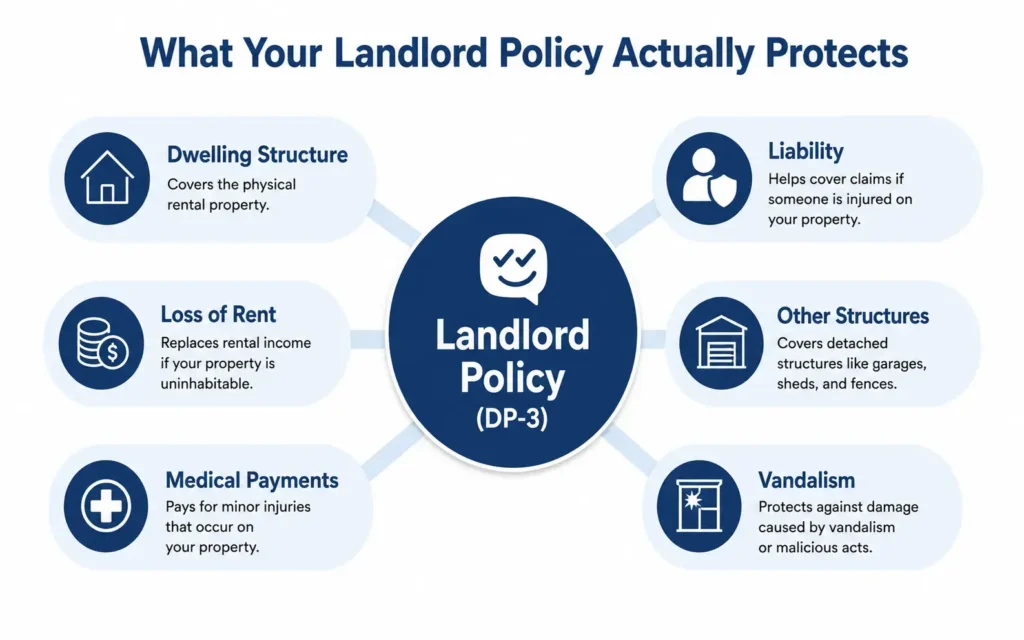
This is the structural protection the bricks, framing, roof, electrical, plumbing, and any built-in fixtures. It covers physical damage to the rental property from named perils on a basic DP-1 form, or on an open-perils basis on a stronger DP-3 form. The DP-3 is the policy most experienced landlords recommend, because it covers everything except a short list of exclusions, rather than only the perils explicitly named.
Standard covered perils on a DP-3 include fire, lightning, windstorm, hail, vandalism, theft, vehicle damage, falling objects, and weight of ice and snow. Excluded items are consistent across carriers: flood, earthquake, intentional damage by the insured, ordinary wear and tear, and damage from rodents or insects. Flood and earthquake are bought separately.
Pillar 2: Liability Coverage
This is the part of the policy that pays when a tenant or visitor is injured on your property and sues you. A tenant slipping on an icy front step, a delivery driver tripping on a loose porch board, a contractor falling from an unsecured ladder every one of these scenarios can produce a six-figure claim. Standard liability limits start at $100,000 per occurrence, but most landlords I work with carry $300,000 or $500,000, and high-net-worth owners stack umbrella coverage on top.
For an extra layer on top of your DP-3, our umbrella insurance for landlords guide walks through how a $1 million umbrella policy typically costs less than $25 per month and covers gaps the underlying policy will not.
Pillar 3: Loss of Rental Income
Often called “loss of rents” or “fair rental value” coverage, this pays the rent you would have collected while the property is uninhabitable due to a covered loss. If a kitchen fire forces a tenant to move out for four months, the policy pays the contracted rent for that period usually for up to 12 or 24 months depending on the carrier. This is the coverage new landlords most often underestimate. A six-month rebuild after a serious fire can easily produce $9,000 to $24,000 in lost rent.
How Landlord Insurance Differs From Homeowners Insurance
Both policies cover dwellings. That is roughly where the similarities end. Here is the breakdown most landlords need to see in one place before they buy:
| Coverage Element | Homeowners (HO-3) | Landlord (DP-3) |
|---|---|---|
| Dwelling structure | Open perils | Open perils |
| Personal property | Yours, fully covered | Limited — only items you keep on-site |
| Loss of use / rent | Living expenses for you | Lost rental income |
| Liability | Personal liability | Premises liability for tenants |
| Medical payments | Standard coverage | Standard coverage |
| Tenant possessions | N/A | Not covered — tenants need renters insurance |
| Typical annual cost | $1,400 – $2,200 | 20–25% higher than HO-3 |
What Landlord Insurance Does Not Cover
The exclusions list matters as much as the coverage list. These are the situations a standard landlord policy will not pay for, regardless of carrier:
- Damage to the tenant’s personal belongings (their renters insurance handles this)
- Intentional damage caused by the tenant (a separate “vandalism by tenant” rider can fill this gap)
- Wear and tear, gradual deterioration, or maintenance issues
- Loss of rent because a tenant simply stopped paying (this is collectible through rent guarantee insurance, sold separately)
- Flood damage from rising water — requires NFIP or private flood policy
- Earthquake damage — requires a separate endorsement or stand-alone policy
- Short-term rental use (Airbnb, Vrbo) — most DP-3 policies exclude this without a specific endorsement
- Mold, unless it directly results from a covered water loss
- Property left vacant for more than 30–60 consecutive days, without a vacancy endorsement
Insurance Savings Calculator
The Short-Term Rental Trap
This deserves a section of its own because it is the most common coverage gap I see. If you list your rental on Airbnb, Vrbo, or any short-term rental platform, a standard landlord policy almost certainly will not cover claims related to that activity. The carrier views short-term rentals as commercial use, which requires either a specific short-term rental endorsement or a separate commercial policy.
Posting a property on a short-term platform without notifying your carrier creates exactly the same problem as renting out a homeowners-insured property: the next claim gets denied, and the policy is canceled. If you are running short-term rentals, ask your agent specifically about a home-sharing endorsement or a commercial dwelling policy.
How Much Coverage Do You Actually Need?
Three numbers drive the right policy size: replacement cost of the building, liability exposure based on the property’s risk profile, and monthly rental income. None of these should be guessed.
For dwelling coverage, never insure for market value insure for replacement cost. The market value of the property includes the land, which cannot burn down. Replacement cost is what it would cost to rebuild the structure today at current construction prices. A property selling for $400,000 in Austin or Tampa might rebuild for $240,000. Insuring for $400,000 means you are overpaying for premiums on coverage you will never use; insuring for $180,000 means a total loss leaves you $60,000 short.
For liability, $300,000 is a baseline. $500,000 is more appropriate for properties with pools, trampolines, decks, or steep stairs, and for landlords with significant personal assets. Above that, an umbrella policy is more cost-efficient than raising the underlying liability limit further.
For loss of rent, choose a benefit equal to at least 12 months of contracted rent. Most carriers default to a much shorter period, sometimes as low as 4 months, which rarely matches actual rebuild timelines.
Typical Cost in 2026
Annual landlord insurance premiums vary substantially by state, but in 2026 most single-family rentals fall in the following ranges. These reflect a $250,000 dwelling limit, $300,000 liability, and 12 months loss of rent:
- Midwest and Mountain states: $1,100 – $1,700 per year
- Texas, Florida, Louisiana (hurricane and hail exposure): $1,800 – $3,600 per year
- California (wildfire-rated zones): $1,500 – $4,200 per year
- Northeast and Mid-Atlantic: $1,300 – $2,100 per year
Multi-unit properties, properties in named-storm zones, and older properties (50+ years) run higher. Bundling multiple rental properties with one carrier typically saves 10–18%.
Frequently Asked Questions (FAQs)
Yes. The moment you collect rent from a tenant, your homeowners policy is no longer the correct product. Some carriers offer a short-term “rented to others” endorsement on a homeowners policy for occasional rentals, but for any rental lease longer than 30 days or recurring rentals, a dedicated DP-3 is the right product.
Yes, and it should be written into the lease. Renters insurance costs tenants about $15–$25 per month and protects their personal belongings items your policy will never cover. It also typically includes liability coverage that protects you from claims your tenant caused, reducing the chance your own policy gets used.
Only for short vacancies. Most policies allow up to 30–60 days of vacancy before coverage begins to lapse for certain claim types particularly vandalism and water damage. If a property will sit vacant longer, request a vacancy permit endorsement at the renewal.
How These Numbers Were Sourced
Coverage definitions in this article follow the ISO DP-3 dwelling policy form, supplemented by state-specific deviations published by the National Association of Insurance Commissioners. Premium ranges reflect 2025–2026 rate filings from the top 12 U.S. landlord insurance carriers. QuoteJoy is independent and accepts no commissions in exchange for favorable carrier placement.
Get the Right Quote for Your Property
Landlord insurance is not a place to save $80 a year by underinsuring. The right policy protects you from one bad claim wiping out years of rental income. To compare DP-3 quotes from multiple top-rated U.S. carriers in about 90 seconds, start with our landlord insurance quote tool it returns side-by-side numbers without requiring a single phone call.