

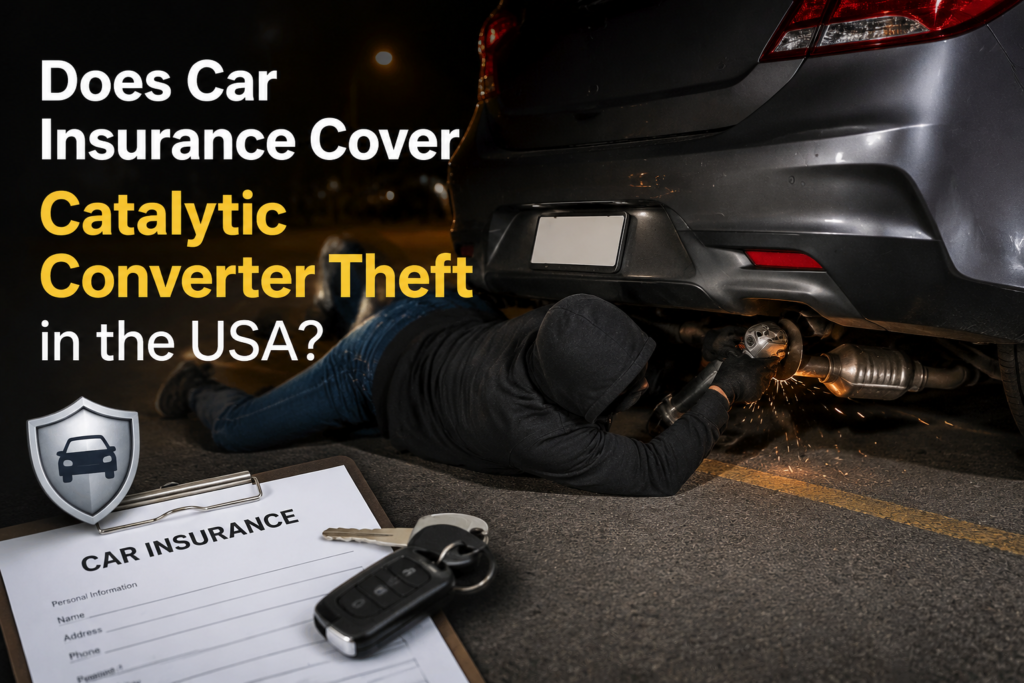
Catalytic converter theft has exploded across the United States since 2020. The National Insurance Crime Bureau (NICB) has reported theft increases of over 1,000% in some metro areas, with thieves taking these emissions-control devices in under two minutes using a battery-powered saw. If you’ve just walked out to your car in a parking lot and heard the deep, broken-muffler roar when you started the engine, you already know what happened and your very next question is almost certainly: does my car insurance actually cover this?
The good news for U.S. drivers is that the answer is yesif you have comprehensive coverage. The bad news is that millions of Americans carry only liability or collision coverage, which won’t pay a cent for a stolen catalytic converter. This guide walks through exactly which part of your U.S. auto policy applies, real 2026 replacement costs by vehicle, how to file a claim the right way, whether your premium will go up afterward, how state law affects coverage (including Texas-specific notes), how to prevent the next theft, and whether the claim is even worth filing in the first place. Every detail you actually need is here.
The short answer
Catalytic converter theft is covered under the comprehensive (also called “other than collision”) portion of a U.S. auto insurance policy. If you carry comprehensive coverage, your insurer will pay to replace the stolen converter and repair any damage thieves caused while removing it minus your comprehensive deductible (typically $250 to $1,000 in the U.S. market). If you do not carry comprehensive coverage, the entire cost is yours, with no insurance help available.
Here’s the quick coverage matrix every American driver should know:
| Your coverage | Catalytic converter theft covered? | Why |
|---|---|---|
| Liability only | NO | Liability only pays for damage you cause to others, not theft from your own car |
| Liability + collision | NO | Collision covers crashes, not theft |
| Liability + comprehensive | YES | Comprehensive specifically covers theft, vandalism, fire, and other non-crash events |
| Full coverage (liability + collision + comprehensive) | YES | Same comprehensive component does the work |
| Uninsured driver | NO | No coverage at all |
If you’re not sure what you have, pull out your most recent declarations page and look for the word “Comprehensive” or “Other Than Collision” with a deductible amount listed. If you see one, you’re covered. If you don’t, you’re not. For a deeper explanation of the three core coverage types, see our guide on what does full coverage car insurance cover.
How much does a catalytic converter actually cost in the USA?
One of the most common questions American drivers ask is: how much is a catalytic converter? The answer varies dramatically by vehicle, because the precious metals inside (platinum, palladium, and rhodium) are exactly what makes them worth stealing in the first place. Here’s what U.S. drivers typically face in 2026:
| Vehicle type | Typical part cost | Labor cost | Total typical U.S. cost |
|---|---|---|---|
| Standard sedan / compact car | $800–$1,800 | $200–$500 | $1,000–$2,300 |
| SUV / pickup truck | $1,500–$3,000 | $300–$700 | $1,800–$3,700 |
| Hybrid (Toyota Prius, etc.) | $2,500–$4,500 | $300–$800 | $2,800–$5,300 |
| Luxury / European cars | $2,000–$5,500 | $400–$900 | $2,400–$6,400 |
| Vehicles with multiple converters | Multiply above | Multiply above | Can exceed $8,000+ |
The Toyota Prius is the most-stolen target in the United States by a wide margin — the hybrid system uses cleaner-running converters with more concentrated precious metals, making them disproportionately valuable to thieves. Honda Element, Ford F-Series trucks, and Lexus RX models are also common American targets. If you own one of these vehicles, your risk is genuinely higher than the average U.S. driver.
On top of the converter itself, thieves often damage exhaust pipes, oxygen sensors, and wiring during the cut. Your insurance claim should include all of this collateral damage, not just the converter itself.
Step-by-step: how to file a catalytic converter theft claim in the USA
If the theft already happened, the right order of actions over the next 24 hours protects both your claim and your timeline to getting back on the road:
- Do not drive the vehicle. A car without a catalytic converter is loud, illegal to drive in most U.S. states (more on this below), and can cause additional damage to the exhaust system, oxygen sensors, and check-engine sensors if driven.
- File a police report immediately. Every U.S. insurer requires a police report number to process a theft claim. Most departments now accept online filings for catalytic converter theft because it’s so common.
- Photograph the damage before anything is moved or repaired the cut pipes, the missing converter, the location of the vehicle.
- Contact your insurer the same day through their app, website, or 24/7 claim line. Provide the police report number, photos, and a description of where and when it happened.
- Get a written repair estimate from a U.S. muffler shop or dealership that specializes in catalytic converter replacement. Many insurers have preferred shops, but you are not required to use them — you can choose your own.
- Decide on OEM vs aftermarket. Original Equipment Manufacturer (OEM) converters cost more but ensure full emissions and check-engine-light compatibility. Aftermarket converters are cheaper but can trigger ongoing issues. Most U.S. insurers will pay for an aftermarket converter; pay the difference yourself if you want OEM.
- Track every related cost. Tow charges, rental car expenses if you have rental reimbursement coverage, and any out-of-pocket payments are typically reimbursable as part of the same claim.
- Repair lead time. Catalytic converters for some vehicles especially older Toyota Priuses and certain European models can have multi-week backorders due to ongoing supply shortages in the U.S. Ask the shop for an estimated timeline upfront so you can plan rentals or alternative transportation.
If your insurer is slow to respond or you suspect you’re being lowballed, you can dispute by submitting a second repair estimate and asking for a re-inspection. U.S. policyholders generally have appeal rights at every step.
Can I drive my car after the catalytic converter is stolen?
Technically the car will start and move but you should not drive it, and in most U.S. states it’s illegal to do so. Three reasons:
- Federal and state emissions laws. Under the U.S. Clean Air Act, vehicles registered for road use must have a functioning catalytic converter. Driving without one can result in fines from state DMVs and emissions authorities.
- State noise ordinances. A car without a catalytic converter is extremely loud typically over 90 decibels at the tailpipe. Most U.S. cities and states enforce noise limits that this exceeds easily.
- Mechanical damage risk. Driving with cut exhaust pipes can damage oxygen sensors, trigger the check engine light, harm the engine’s air/fuel ratio, and let dangerous exhaust gases into the cabin. Repairs become more expensive the longer you drive on a damaged exhaust.
Best practice: leave the car parked at home or have it towed directly to the repair shop do not drive it to the shop yourself. Tow costs are usually covered if you have roadside assistance or rental/towing endorsements on your U.S. auto policy.
Will my insurance go up if I file a catalytic converter theft claim?
Possibly — but usually less than American drivers fear. Catalytic converter theft is a comprehensive (not-at-fault) claim, which means U.S. insurers typically treat it more leniently than at-fault accident claims. A few realities:
- Premium impact varies by carrier and state. Some U.S. carriers don’t raise rates at all for a single comprehensive claim. Others raise rates by 5–15%, typically for 3–5 years.
- Multiple comprehensive claims in a short period matter more. Two theft claims within 2–3 years can lead to a meaningful premium increase or even non-renewal in some U.S. states.
- State law caps some increases. California and a few other U.S. states limit how much insurers can raise rates after not-at-fault claims. Texas and most others allow more flexibility.
- Your CLUE report tracks it. All comprehensive claims go on your Comprehensive Loss Underwriting Exchange (CLUE) report and remain visible to future insurers for 5–7 years.
The decision math: if your repair is $2,500 with a $500 deductible, your insurer pays $2,000. If your rate then rises $20/month for 3 years, that’s $720 in extra premium. Net savings: about $1,280 by filing. The bigger the gap between repair cost and deductible, the more obviously worthwhile the claim is. For smaller losses, paying out of pocket can sometimes save money long-term.
If you do see a meaningful rate hike at renewal, that’s the moment to compare carriers see how to switch car insurance for the right way to switch without a coverage gap.
Carrier-specific notes (State Farm, AAA, and others)
American drivers often ask whether specific U.S. carriers handle catalytic converter theft differently. The honest answer: all major U.S. carriers cover it the same way through the comprehensive component of the policy. The differences are in deductibles, claim service, repair-shop networks, and renewal pricing. A few patterns:
- State Farm, GEICO, Progressive, Allstate, Liberty Mutual, Farmers, USAA, Travelers, Nationwide: all standard major U.S. carriers cover catalytic converter theft under comprehensive. There is no carrier in the U.S. mainstream market that singles this out as a special exclusion.
- AAA insurance: also covers under comprehensive same as the mainstream carriers above. AAA’s roadside towing benefit is often used alongside the insurance claim to get the disabled vehicle to a shop.
- Specialty / non-standard carriers (used by drivers with poor records or other risk factors): coverage rules are sometimes more restrictive. Always read your specific declarations page.
Bottom line: the company name matters less than whether you have comprehensive coverage on your policy. If you do, you’re covered. If you’ve been priced out of comprehensive recently, see our guide on car insurance for bad credit for U.S. carriers that are often more lenient on tough profiles.
State-specific notes (Texas and others)
U.S. catalytic converter laws and theft enforcement vary by state, which affects both your prevention strategy and what to expect from local police:
- Texas: has passed some of the strongest anti-theft laws in the United States. Texas requires scrap metal dealers to verify seller identity, document each transaction, and report suspicious sales making converters harder for thieves to sell. Insurance coverage works the same as anywhere else, but Texas police now investigate these thefts more aggressively.
- California: introduced laws in 2023 requiring catalytic converters sold for scrap to be traceable to the vehicle owner. Combined with strong CA consumer protection laws, this has reduced theft in some metro areas.
- Minnesota, Illinois, Colorado, Washington: also have specific traceability or scrap-purchase restrictions.
- Most other U.S. states: rely on general theft statutes; coverage and claim process is identical.
Regardless of state, the insurance side is consistent across the U.S. comprehensive coverage pays, liability/collision does not.
How to prevent catalytic converter theft in the USA
Catalytic converter theft is largely a crime of opportunity thieves want fast, quiet targets. American drivers can dramatically reduce risk with a few specific steps:
- Park in a garage when possible. The single most effective prevention. Thieves rarely enter enclosed garages.
- Park in well-lit, busy areas. If garage parking isn’t available, choose locations with foot traffic, security cameras, and lighting.
- Install a catalytic converter shield or “cat shield.” Steel or aluminum cages bolt over the converter and make theft significantly harder. U.S. installers charge $200–$500 for most vehicles. Several U.S. insurers offer 5–10% premium discounts for installation.
- Etch your VIN onto the converter. Free at many U.S. police department events, etching helps police identify recovered converters and discourages purchase by scrap dealers.
- Install a tilt/motion alarm. Modern car alarms can detect the vibration of a saw cutting your exhaust and trigger before the converter is fully removed.
- Park with the catalytic converter side close to a wall in driveways and lots makes access harder.
- For Toyota Priuses specifically: consider a converter “sleeve” or specialized cage designed for that model, since it’s the most-stolen vehicle in the United States.
- Check your insurance discounts. Some U.S. carriers reduce comprehensive premiums for verifiable anti-theft devices.
Prevention is dramatically cheaper than the alternative even a $400 shield is a tiny fraction of a $3,000 repair bill, and you avoid the claim, the deductible, and any potential rate increase. If you want to layer in additional savings strategies, see 11 ways to lower your car insurance rates.
What if my catalytic converter was stolen more than once?
Unfortunately, this is increasingly common in U.S. metro areas some Toyota Prius owners have had two or three converters stolen within a year. Things to know:
- Each theft is a separate claim, with a separate deductible. You don’t get a discount for repeat losses.
- Multiple comprehensive claims can affect your premium more than a single claim, even though each is individually not-at-fault.
- Some U.S. insurers may add restrictions after multiple claims higher deductibles, exclusions on certain perils, or non-renewal.
- Anti-theft devices become even more critical the financial case for a converter cage or alarm system becomes overwhelming after the first theft.
- Document everything thoroughly second and subsequent claims face more scrutiny.
If you’ve had multiple thefts and your renewal premium spikes, this is exactly when comparing other U.S. carriers pays off most different insurers weigh repeat comprehensive claims very differently.
Should I file the claim or pay out of pocket?
Quick decision framework for American drivers:
| Repair cost | Your deductible | Should you file? |
|---|---|---|
| $800 | $1,000 | NO — below deductible |
| $1,200 | $500 | Borderline — small net benefit, watch rate impact |
| $2,500 | $500 | YES — clear benefit |
| $4,500 | $1,000 | YES — strongly worth it |
| $5,000+ (Prius / luxury) | Any | YES — file immediately |
The rule of thumb: if the repair cost is less than 1.5× your deductible, the long-term premium impact may outweigh the immediate payout. If it’s 2× your deductible or more, file.
Frequently asked questions
Does car insurance cover catalytic converter theft in the USA?
Yes — but only if you carry comprehensive coverage. Comprehensive (also called “other than collision”) pays for theft, vandalism, fire, and other non-crash events. If you only have liability or collision coverage, catalytic converter theft is not covered and the entire repair cost is yours.
Will my insurance go up if my catalytic converter is stolen?
Possibly, but usually less than for an at-fault accident. Some U.S. carriers don’t raise rates for a single comprehensive claim; others increase rates 5–15% for 3–5 years. Multiple comprehensive claims in a short period have a bigger impact. Compare carriers if your renewal premium spikes.
Can I drive my car if the catalytic converter is stolen?
No, you shouldn’t, and in most U.S. states it’s illegal under federal Clean Air Act and state emissions laws. The car is also dangerously loud, can damage your exhaust system further, and may allow harmful exhaust gases into the cabin. Have it towed to a repair shop instead of driving.
Does insurance cover catalytic converter replacement?
Yes, when the converter was stolen or damaged by a covered peril comprehensive coverage pays for replacement parts and labor, minus your deductible. Insurance does not cover replacement due to normal wear, mechanical failure, or emissions inspection failures unrelated to a covered event.
How much does a catalytic converter cost in the USA?
Replacement costs vary widely by vehicle in 2026: $1,000–$2,300 for most sedans, $1,800–$3,700 for SUVs and pickups, and $2,800–$5,300 for hybrids like the Toyota Prius. Luxury and European vehicles can run $6,000+, and some vehicles have multiple converters that compound the cost.
Does State Farm, GEICO, or AAA insurance cover catalytic converter theft?
Yes — every major U.S. carrier, including State Farm, GEICO, Progressive, Allstate, USAA, Liberty Mutual, AAA, and Farmers, covers catalytic converter theft under their comprehensive coverage. The carrier name doesn’t change the coverage; what matters is whether comprehensive is included on your specific policy.
How can I prevent catalytic converter theft on my car?
The most effective steps are: park in a garage when possible, install a catalytic converter shield ($200–$500 in the U.S.), etch your VIN onto the converter, park in well-lit areas, and install a vibration-detecting car alarm. For high-risk vehicles like the Toyota Prius, a model-specific shield is well worth the cost.
The bottom line
Catalytic converter theft is one of the fastest-growing vehicle crimes in the United States, but the insurance answer is clear: comprehensive coverage pays, liability and collision do not. If you have comprehensive on your U.S. auto policy, your insurer will replace the converter and repair related damage minus your deductible. If you don’t, the entire cost ranging from about $1,000 for a standard sedan to over $5,000 for a Toyota Prius is yours to absorb.
After a theft, the right sequence is: don’t drive the vehicle, file a police report, contact your insurer the same day, get a written repair estimate, and decide on OEM vs aftermarket replacement. Whether to file the claim depends mostly on the gap between repair cost and your deductible large losses are clearly worth filing; very small losses sometimes aren’t. Prevention through shields, garaged parking, and VIN etching is dramatically cheaper than a repeat theft.If your current U.S. auto policy doesn’t include comprehensive coverage or your premium has jumped after a recent claim it’s the right moment to compare. Get a car insurance quote on QuoteJoy and see what comprehensive coverage actually costs across top U.S. carriers. You can start an auto quote here, or contact our team if you want help reviewing your existing policy. For the wider auto coverage picture, see our guides on what does full coverage car insurance cover and how to lower your car insurance rates.