

Frequently asked questions about switching car insurance
f your car insurance bill keeps climbing every renewal, you are not alone — and you do not have to accept it. Across the United States, millions of drivers overpay for years simply because they assume switching insurers is complicated, risky, or that they’ll be charged a penalty for leaving early. None of that is true.
In every U.S. state, you can switch car insurance whenever you want, even in the middle of your policy term, and there is no government or industry penalty for doing so.
Switching is actually one of the fastest, lowest-effort ways for American drivers to cut their premium. U.S. insurers price the exact same driver very differently, and the company that was cheapest when you first signed up is rarely still the cheapest two or three years later.
In this guide, you’ll learn exactly how to switch car insurance the right way step by step so you save money without ever paying for two policies at once or leaving a dangerous coverage gap that could put you in violation of your state’s insurance laws.
Yes. In the U.S., you are not locked into your policy for its full six- or twelve-month term. You can cancel and switch the moment you find a better deal. The only thing that matters is the order in which you do it cancel the wrong way and you can either lose coverage for a day (illegal in nearly every state, including California, Texas, Florida, and New York) or trigger a fee you didn’t need to pay.
Most major U.S. carriers prorate your refund, too. If you paid six months upfront and cancel after three, you generally get roughly half of your premium back for the unused portion. So switching mid-term doesn’t mean throwing away the money you’ve already paid say you prepaid $900 for six months; cancel at the halfway point and you’d typically see around $450 returned.
Bottom line: there is never a bad time to shop in the U.S. market. The best time is whenever your rate goes up or whenever it’s been a year or more since you last compared.
There is no legal penalty anywhere in the United States for switching car insurance. A small number of insurers charge a “short-rate” cancellation fee usually a tiny percentage of the unused premium but many charge nothing at all. Either way, that fee is almost always dwarfed by the savings from a cheaper policy, so the math overwhelmingly favors switching when you’ve found a better rate.
There is, however, one mistake that genuinely hurts U.S. drivers: simply stopping payment on your old policy to “cancel” it. That triggers a non-payment cancellation, which can be reported to state databases and the insurance industry’s shared claims history, causing your next insurer to raise your rate. Always cancel formally and in writing never by just letting the policy lapse.
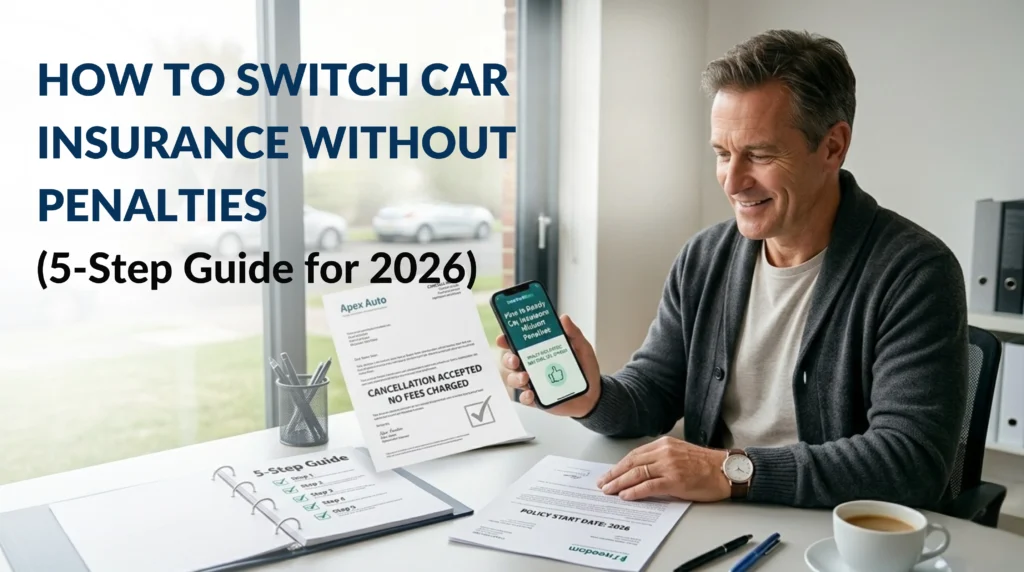
The 5 steps to switch car insurance the right way
Follow these five steps in order and the entire switch takes about 30 minutes with zero coverage gaps and zero surprises, no matter which state you live in.
Step 1: Compare quotes before you cancel anything
This is the golden rule of switching: line up your new policy before you touch the old one. Gather quotes from several U.S. carriers so you’re comparing real numbers instead of guessing. Keep your current declarations page handy it lists your exact coverage limits and deductibles, which lets you compare apples to apples.
When you compare, match identical coverage levels across every quote, and make sure each one at least meets your state’s minimum liability requirements (these vary widely — for example, a state like Florida sets different minimums than California or Texas).
A “cheaper” policy that quietly lowers your liability limits below your state minimum or raises your deductible isn’t actually cheaper it’s just less protection, and potentially non-compliant. The fastest way to do this correctly is to compare car insurance quotes from top U.S. carriers on QuoteJoy, where you can see matching coverage side by side in a couple of minutes.
While you’re shopping, this is also the perfect moment to look for discounts you may be missing bundling, low-mileage, safe-driver, and more. Our guide to 11 proven ways to lower your car insurance rates pairs perfectly with switching, because you can stack those savings on top of a cheaper base rate.
Step 2: Confirm your new policy’s start date
Choose a start date for the new policy that is the same day as or one day before the cancellation date of your old policy. Overlapping by a single day costs you almost nothing and guarantees there is no gap in your coverage. Even a 24-hour gap can lead to higher rates down the road, a lapse notation on your insurance record, and serious legal exposure: driving uninsured is illegal in 48 states and can mean fines, license suspension, and SR-22 filing requirements.
Never cancel the old policy first and “figure out the new one tomorrow.” Always have the new coverage active before the old one ends.
Step 3: Cancel your old policy in writing
Once your new policy is officially active, contact your old insurer to cancel. Many require a signed cancellation request or a quick phone call; some accept email. Ask for written confirmation of both the cancellation and its effective date, and if you prepaid, ask specifically about your prorated refund.
Don’t assume your old policy cancels itself just because you bought a new one. The two companies don’t communicate. It’s on you to formally close the old account. Skipping this step can leave you double-billed or, worse, marked as a non-payment cancellation on the U.S. insurance databases insurers check.
Step 4: Notify your lender or leasing company
If you finance or lease your vehicle as most American drivers do the lender is listed as a lienholder and must be named on your new policy. Send your new insurer the lienholder’s details and make sure the lender receives proof of the new coverage. If you skip this, the lender may assume you’re uninsured and buy expensive “force-placed” insurance on your behalf then bill you for it, often at several times the normal cost (sometimes hundreds of dollars more per month).
Step 5: Get your new proof of insurance and remove the old card
Download or print your new insurance ID card and keep it both in your vehicle and on your phone. In most U.S. states you’re required to show proof of insurance during a traffic stop or at vehicle registration, so remove the old card to avoid accidentally handing an expired one to a police officer or the DMV. That’s it you’ve officially switched, with no gap and no penalty.
When is the best time to switch car insurance?
You can switch any time, but a few moments are especially smart for U.S. drivers because that’s when your rate is most likely to be out of step with the market:
- At renewal. Your insurer mails a renewal notice with your new rate. If it went up even a little, that’s your cue to shop before you re-commit for another term.
- After a life change. Moving to a new state or ZIP code, getting married, adding or removing a driver, buying a different vehicle, or improving your credit can all change which carrier is cheapest for you. Moving across state lines is an especially big one, since rates are regulated state by state.
- After your record improves. When an accident, ticket, or claim ages off your record (usually after 3–5 years in most states), you may suddenly qualify for far lower rates elsewhere.
- When you’ve been with one company 3+ years. Loyalty rarely pays in the U.S. insurance market. Many insurers quietly raise long-term customers’ rates, assuming they won’t shop. Re-compare periodically to keep them honest.
How much can U.S. drivers actually save by switching?
Savings vary by driver and state, but Americans who shop around regularly often save a meaningful amount, frequently a few hundred dollars a year, and sometimes far more for one simple reason: insurers weigh your profile very differently.
One company might heavily penalize a past claim, a lower credit-based insurance score (which is used in most states), or a young driver on your policy, while another barely factors those in. The only way to find the carrier that views your profile most favorably is to compare several at once.
Here’s a simplified illustration of how the same driver can be priced differently across U.S. carriers (figures are illustrative, not guaranteed quotes):
| Driver profile | Carrier A (annual) | Carrier B (annual) | Potential savings |
|---|---|---|---|
| Clean record, good credit | $1,450 | $1,180 | $270 |
| One past at-fault claim | $2,100 | $1,650 | $450 |
| Teen driver added | $3,400 | $2,750 | $650 |
If you’re a newer driver or insuring a teen, the gap between the cheapest and most expensive quote can be enormous. Our breakdown of the cheapest car insurance for new drivers shows just how wide that range gets in the U.S. and why comparing is non-negotiable.
Will switching car insurance hurt my credit or my record?
No. Getting insurance quotes does not affect your credit score the way applying for a loan or credit card does U.S. insurers use a “soft” inquiry that’s invisible to lenders. And switching itself doesn’t create any negative mark on your insurance record, as long as you avoid a coverage lapse and don’t cancel by non-payment.
In fact, maintaining continuous coverage while switching is a positive signal that helps keep your future rates low. (Note: a handful of states, including California, Hawaii, and Massachusetts, restrict or ban the use of credit in auto insurance pricing.)
Common mistakes to avoid when switching
Most switching problems come down to a handful of avoidable errors. Watch out for these:
- Letting coverage lapse. Always overlap your policies — never leave a gap, not even for a day, given that driving uninsured is illegal in nearly every state.
- Canceling by non-payment. Always cancel formally and in writing so it’s never recorded as a missed payment.
- Dropping below your state minimum. Match your liability limits and deductibles, and never go under your state’s required minimum coverage.
- Forgetting the lienholder. If you finance or lease, notify the lender every time you change insurers.
- Not claiming your refund. Prepaid premium for the unused term is your money — ask for it back.
- Shopping only one company. A single quote tells you nothing about whether it’s competitive. Always compare several U.S. carriers.
A quick switching checklist
Before you finalize the switch, make sure you can check every box:
- Compared multiple U.S. carriers at matching coverage levels (meeting your state minimum)
- Locked in a new policy start date that overlaps the old one
- Confirmed the new policy is active
- Cancelled the old policy in writing and got confirmation
- Updated your lienholder (if financing or leasing)
- Saved your new proof of insurance and removed the old card
- Requested any prorated refund owed to you
Yes. In every U.S. state you can cancel and switch at any point during your policy term — you don’t have to wait until renewal. Most insurers will refund the unused portion of your premium on a prorated basis, so you won’t lose the money you already paid for coverage you won’t use..
There’s no legal penalty in the U.S. for switching. A few insurers charge a small short-rate cancellation fee on mid-term cancellations, but many charge nothing, and any fee is almost always far smaller than the savings from a cheaper policy. Just be sure to cancel formally rather than by stopping payment.
No. Insurance quotes use a soft inquiry that does not affect your credit score and isn’t visible to lenders. You can compare as many quotes as you like without any impact on your credit. Note that some states limit how much credit can factor into your rate in the first place.
The actual switch usually takes about 30 minutes once you’ve compared quotes. Buying the new policy is near-instant online, and canceling the old one is typically a quick call, signed form, or email. In most cases the new coverage can start the same day.
You must cancel the old policy yourself, in writing. It does not cancel automatically just because you bought a new policy the two companies don’t communicate. Ask for written confirmation and the effective cancellation date so you aren’t double-billed or flagged for non-payment.
Not if you do it in the right order. Set your new policy’s start date to overlap the old one by at least a day, and only cancel the old policy once the new one is active. That guarantees continuous coverage with no gap and no lapse important because driving uninsured is illegal in nearly every U.S. state.
Yes, you can still switch, but an open claim stays with the insurer you had at the time of the incident — it doesn’t transfer to the new company. A recent accident may affect your new quotes, so it’s especially worth comparing several U.S. carriers, since each weighs accidents differently.
The bottom line
Switching car insurance in the U.S. is quick, free of any real penalty, and one of the most reliable ways for American drivers to stop overpaying. Shop first, line up the new policy, overlap the dates, cancel the old one in writing, and update your lender. Done in the right order, the whole process takes about half an hour and leaves you with identical (or better) coverage at a lower price while keeping you fully compliant with your state’s insurance laws.
Ready to find out if you’re overpaying? Compare free car insurance quotes on QuoteJoy and see your real options across top U.S. carriers in minutes — no obligation, no pressure. Still have questions about making the switch? Get in touch with our team and we’ll walk you through it.