

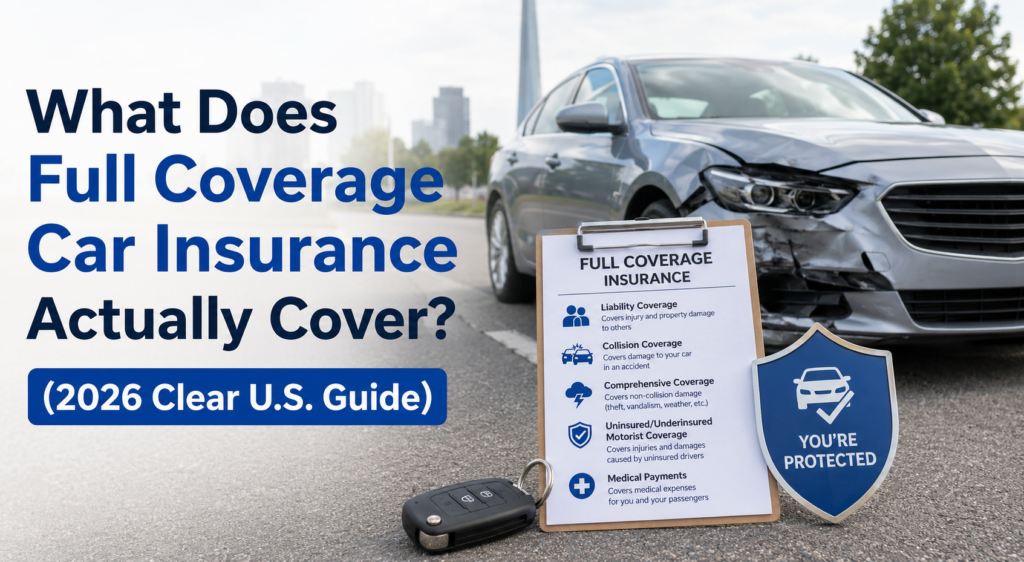
Full coverage” is the most misunderstood phrase in U.S. car insurance. It sounds like it covers literally everything every dent, every theft, every medical bill, every dollar of damage. But here’s the truth: full coverage isn’t actually an official policy type sold in any U.S. state. It’s industry shorthand for a common combination of coverages nothing more, nothing less. Knowing what’s really inside that bundle (and, just as importantly, what isn’t) is the difference between being properly protected and paying for things you don’t need.
This guide walks U.S. drivers through exactly what full coverage car insurance includes, what it leaves out, when you genuinely need it, when you can safely drop parts of it, what it typically costs, and how the bundle differs in each state. By the end, you’ll be able to read any auto quote with full confidence and know whether the policy in front of you is actually full coverage, or just a thinly disguised liability-only plan.
What “full coverage” really means in the U.S.
There is no single coverage in the U.S. called “full coverage.” When an American lender, dealer, or insurance agent says “full coverage,” they almost always mean a policy that combines three core coverages:
| Coverage | What it pays for | Required? |
|---|---|---|
| Liability | Damage / injuries you cause to others | Required by law in every U.S. state except NH and (mostly) VA |
| Collision | Damage to your car from a crash | Required by lenders if you finance or lease |
| Comprehensive | Damage to your car from non-crash events | Required by lenders if you finance or lease |
Bundle those three and U.S. drivers call it “full coverage.” But many real-world full-coverage policies also include several add-on coverages, depending on your state and how the agent built the quote: uninsured/underinsured motorist (UM/UIM), medical payments (MedPay), personal injury protection (PIP), gap insurance, rental reimbursement, and roadside assistance. Whether those add-ons are bundled in or not is one of the biggest reasons two “full coverage” quotes can differ by hundreds of dollars.
The 3 core parts of full coverage
1. Liability coverage pays for the *other* person
Liability is the legally required foundation of every U.S. auto policy. It pays for injuries and property damage you cause to *other people* in an at-fault accident. It has two parts:
- Bodily injury liability (BI) covers other people’s medical bills, lost wages, pain and suffering, and your legal costs if you injure them. Usually written as two limits, e.g. $25K/$50K = $25,000 per person / $50,000 per accident.
- Property damage liability (PD) covers the repair or replacement of the other driver’s car, plus other property like fences, mailboxes, buildings, and utility poles. Written as a single limit, e.g. $25K.
Important: liability does NOT pay for your own car or your own injuries. That’s what the next two coverages and several add-ons are for. State minimum liability requirements vary widely; here’s how they look across major U.S. states:
| State | Minimum BI per person / per accident | Minimum PD | Notes |
|---|---|---|---|
| California | $15K / $30K | $5K | Among lowest in U.S. |
| Texas | $30K / $60K | $25K | Mid-range minimums |
| Florida | No BI required | $10K | Unique no-fault state; PIP required |
| New York | $25K / $50K | $10K | Plus PIP / UM required |
| Pennsylvania | $15K / $30K | $5K | Choice no-fault state |
| NHTSA recommendation | $100K / $300K | $100K | Far above any state minimum |
Most U.S. financial advisors recommend carrying limits at least 100/300/100, regardless of your state minimum state minimums are dangerously low in many places and rarely cover a serious accident’s real cost.
2. Collision coverage pays to fix *your* car after a crash
Collision pays to repair or replace your vehicle when you hit another car or object a guardrail, a pole, a tree, a deer-jump-aside-and-into-a-ditch regardless of who was at fault. It also covers single-car accidents like rollovers, sliding off the road on ice, and collisions with a pothole that bends your wheel. You pay your deductible (typically $500–$1,000 in the U.S.), and the insurer covers the rest up to your car’s actual cash value (ACV) at the time of the loss.
Two collision details every American driver should know:
- Payouts are capped at ACV, not what you paid. A car you bought for $35,000 three years ago might be worth $22,000 today. If it’s totaled, that’s what the insurer owes, minus your deductible not the original $35,000.
- Choosing your deductible is a balancing act. A $250 deductible costs more in premium but pays out more after a claim; a $1,500 deductible costs less per month but stings more when you actually need to file.
3. Comprehensive coverage pays for *non-crash* damage
Comprehensive (sometimes called “other than collision”) covers damage that isn’t from a collision. The U.S. list typically includes:
- Theft of the vehicle
- Vandalism and break-ins
- Fire and explosion
- Falling objects (tree branches, hail huge in Texas, Oklahoma, and the Plains)
- Flooding and storm damage (Florida, Gulf Coast, hurricane states)
- Hitting an animal (deer collisions are especially common in Pennsylvania, Michigan, and West Virginia)
- Broken windshields and glass damage
- Civil unrest and certain riot-related damage
Like collision, comprehensive has a deductible (often $0–$500 for glass; $250–$1,000 for other claims), and payouts are capped at the car’s actual cash value.
What full coverage does NOT cover (the gaps Americans miss)
This is where U.S. drivers get caught off guard. Even “full coverage” leaves real gaps unless you add the right endorsements:
- Your own medical bills unless you add Medical Payments (MedPay) or, in no-fault states like Florida, New York, Michigan, and Pennsylvania, Personal Injury Protection (PIP), which is often mandatory.
- The gap between what you owe and your car’s value if your car is totaled and you owe more on the loan or lease than it’s worth, you need gap insurance to cover the difference. Critical for anyone financing a new car most new vehicles depreciate 20%+ in the first year alone.
- Damage from an uninsured or underinsured driver about 1 in 7 U.S. drivers is uninsured on any given day. Uninsured / underinsured motorist (UM/UIM) coverage fills this gap, and is required in roughly half of states.
- Mechanical breakdowns and normal wear insurance isn’t a warranty. Worn brakes, failed transmissions, dead batteries, and oil leaks are on you.
- Personal belongings stolen from the car those usually fall under your homeowners or renters insurance, not your auto policy. Your laptop, golf clubs, or AirPods aren’t covered by your car insurer.
- Rideshare or delivery driving if you drive for Uber, Lyft, DoorDash, Instacart, or Amazon Flex, you typically need a rideshare endorsement or commercial policy. Personal auto policies often exclude commercial use entirely.
- Custom parts and aftermarket equipment lift kits, custom wheels, premium audio, exterior wraps often need to be scheduled separately. Default limits are usually only $1,000–$1,500.
- Rental cars while yours is in the shop needs a rental reimbursement endorsement (typically $30–$50/day).
So “full coverage” in the U.S. is comprehensive in the sense of covering most accident scenarios but it is far from unlimited.
Common U.S. add-ons that turn a basic policy into real full coverage
If you want the policy that most people *think* full coverage already is, layer in these endorsements:
| Add-on | What it does | Who should add it |
|---|---|---|
| UM / UIM | Pays when an uninsured / underinsured driver hits you | Everyone in states where it’s optional |
| MedPay | Pays medical bills regardless of fault | Drivers without strong health insurance |
| PIP | No-fault medical + lost wages | Required in no-fault states (FL, NY, MI, etc.) |
| Gap insurance | Pays loan/lease balance above ACV | Anyone financing or leasing a newer car |
| Rental reimbursement | Rental car while yours is in the shop | Drivers without a backup vehicle |
| Roadside assistance | Tow, jump, lockout, flat tire | Easier than buying AAA in many cases |
| Rideshare endorsement | Coverage while driving for Uber/Lyft/etc. | Gig drivers |
Do you actually need full coverage? (The U.S. decision framework)
Full coverage makes the most sense for American drivers when:
- Your car is financed or leased U.S. lenders almost always require collision and comprehensive as a condition of the loan or lease, and many also require gap coverage.
- Your car is newer or worth more than about $5,000–$7,000 the repair/replacement protection is worth the premium.
- You couldn’t afford to replace your car out of pocket if it were totaled tomorrow.
- You drive in a high-claim area dense urban traffic, hail-prone Midwest, hurricane-prone Gulf Coast, deer-heavy rural roads, or high-theft cities.
You might consider dropping collision and comprehensive (keeping liability-only) when:
- Your car is older and low in value. A common U.S. rule of thumb: if your annual collision + comprehensive premium is more than about 10% of your car’s value, the coverage may not pay off mathematically.
- You have enough savings to comfortably replace the car yourself.
- Your loan is paid off (so no lender is forcing the coverage).
Here’s a quick worked example using illustrative U.S. figures: a 2008 sedan worth $4,500. Full coverage costs $1,400/year; liability-only costs $620/year. Difference: $780/year for $4,500 of potential payout (minus a $1,000 deductible so realistically $3,500). In about 4–5 years of premium difference, you’ve paid the car’s value to the insurer. For many older-car owners, dropping to liability and self-insuring makes financial sense.
How much does full coverage cost vs. liability only in the U.S.?
Full coverage costs noticeably more than liability-only because you’re adding two extra coverages (collision and comprehensive) plus, usually, higher liability limits and add-ons. But the right comparison isn’t full vs. liability in the abstract it’s full coverage from *Carrier A* vs. *Carrier B* vs. *Carrier C*, because the same bundle can be priced dramatically differently across U.S. insurers.
Illustrative annual U.S. ranges (not guaranteed quotes):
| Driver profile | Liability only | Full coverage | Difference |
|---|---|---|---|
| Clean record, good credit, late-model car | $650 / yr | $1,400 / yr | +$750 |
| 1 ticket, average credit | $900 / yr | $1,900 / yr | +$1,000 |
| Teen driver added, financed car | $1,800 / yr | $3,600 / yr | +$1,800 |
| Older car, clean record | $580 / yr | $1,250 / yr | +$670 |
That’s exactly why shopping matters. The cheapest full-coverage policy for your neighbor might be one of the priciest for you. If you’re switching policies, our guide on how to switch car insurance walks through the right order; if your credit is hurting your rate, car insurance for bad credit explains how U.S. carriers weigh credit differently.
Full coverage vs. liability: side-by-side
To make the choice crystal clear for U.S. drivers:
| Question | Liability only | Full coverage |
|---|---|---|
| Covers other driver’s damage and injuries? | YES | YES |
| Covers YOUR car after a crash? | NO | YES (collision) |
| Covers YOUR car from theft / hail / fire / flood? | NO | YES (comprehensive) |
| Required by law? | Yes, in 48 states | No (but lenders require) |
| Required by lender if financing/leasing? | No — not enough | YES |
| Typical annual U.S. cost | $500 – $900 | $1,200 – $2,000+ |
Ways to lower the cost of full coverage in the U.S.
If full coverage is the right call but the price stings, several U.S. levers can bring it down:
- Raise your deductible. Going from $500 to $1,000 (or $1,500) on collision and comprehensive can cut your premium meaningfully just make sure you can cover that amount after a claim.
- Bundle home/renters and auto. Most U.S. carriers offer 10–25% off when you bundle.
- Enroll in a telematics / usage-based program. Safe-driving programs from major U.S. insurers can knock 10–30% off.
- Stack every discount. Multi-car, paperless billing, pay-in-full, defensive-driving course, military, alumni, and student-good-grades discounts all add up.
- Shop aggressively. See our guide on lowering your car insurance rates for the full playbook.
Right-size liability and add-ons. Don’t over-insure (e.g., adding rental reimbursement when you have a second car at home), but don’t under-insure either.
Frequently asked questions about full coverage car insurance
Full coverage” isn’t an official policy type sold in any U.S. state. It’s industry shorthand for a bundle that combines liability, collision, and comprehensive coverage usually plus required add-ons like uninsured motorist (UM/UIM) and, in no-fault states, personal injury protection (PIP). Two “full coverage” quotes can include different add-ons, so always check what’s actually inside the bundle.
You need full coverage in the U.S. if your car is financed or leased lenders almost always require it. You probably want it if your car is newer or worth more than about $5,000–$7,000. You may not need it if your car is older, fully paid off, and you can afford to replace it from savings.
Yes those are covered under the comprehensive portion of full coverage. The same applies to fire, hail, flood, falling objects, animal collisions, and broken windshields. You pay your comprehensive deductible (often $250–$1,000), and the insurer covers the rest up to your car’s actual cash value.
Not automatically. The liability portion of full coverage pays for the *other* person’s injuries, not yours. To cover your own medical bills you need Medical Payments (MedPay) or, in no-fault states like Florida, New York, and Michigan, Personal Injury Protection (PIP) which is often required in those states.
Usually no. Gap insurance which pays the difference between what you owe on a car loan/lease and the car’s actual cash value if it’s totaled — is a separate add-on in the U.S. It’s strongly recommended for anyone financing a newer vehicle, especially in the first 2–3 years of ownership.
Yes, often by 2–3x. Illustrative U.S. ranges: liability-only might run $500–$900 a year, while full coverage commonly runs $1,200–$2,000+. The exact difference depends on your car’s value, your state, your driving record, and how heavily a particular carrier weighs your profile.
A common U.S. rule of thumb: drop collision and comprehensive when your annual premium for both exceeds about 10% of your car’s value, or when the maximum possible payout (ACV minus deductible) no longer justifies the cost. Always keep liability it’s legally required in nearly every state and protects you from financially catastrophic lawsuits.
The bottom line
“Full coverage” in the U.S. = liability + collision + comprehensive, usually plus a few common add-ons. It protects the other driver, your own car in a crash, and your own car against theft, weather, animals, and other non-crash events. It does NOT cover your medical bills, loan gaps, uninsured drivers, mechanical failure, or rideshare/delivery work without add-ons so always check what’s actually bundled into any quote.
Full coverage is essential while you’re financing or leasing, and usually smart for newer or higher-value vehicles. Once your car ages and your loan is paid off, it’s worth running the math on whether collision and comprehensive still pay off sometimes they do, sometimes they don’t.
Want to see what full coverage actually costs for your specific car and ZIP code? Compare full-coverage car insurance quotes on QuoteJoy and match identical coverage across top U.S. carriers in minutes. You can contact our team if you’d like help building the right bundle. If you’re a newer driver, our breakdown of the cheapest car insurance for new drivers is worth a look too.