

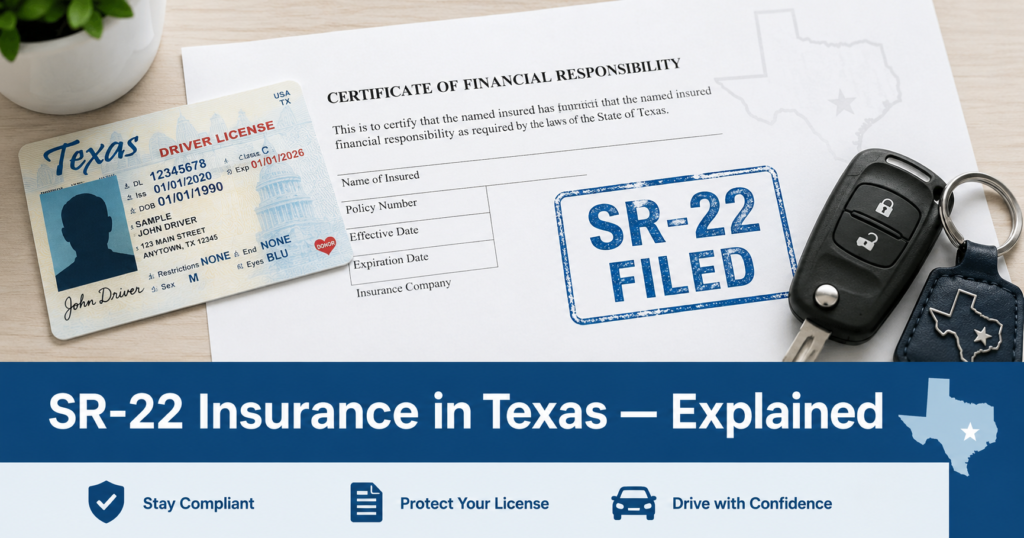
If a Texas court or the Department of Public Safety has told you that you need an SR-22, you probably have two questions: what exactly is it, and how much is this going to cost? The short answer is reassuring. An SR-22 is not a special type of insurance and it is not a punishment that follows you forever. It is a form your insurer files with the state to prove you carry the liability coverage every driver in the United States is expected to maintain. Thousands of Texans file one every year after a ticket for driving without insurance, a DWI, or a license suspension and most see their rates return to normal once the filing period ends.
This guide walks through how the SR-22 works in Texas specifically: the situations that trigger it, the two-year filing rule, what it costs on top of a regular policy, the difference between an SR-22 and an SR-22A, and what to do if you don’t own a car. Everything here is based on Texas Transportation Code Chapter 601 and guidance published by the Texas Department of Insurance (TDI) and the Texas Department of Public Safety (DPS).
What Is an SR-22 in Texas?
An SR-22 is a certificate of financial responsibility. In plain English, it is proof filed directly by your insurance company with the Texas DPS that you carry at least the state’s minimum liability limits. Texas requires every driver to carry 30/60/25 coverage: $30,000 in bodily injury liability per person, $60,000 per accident, and $25,000 for property damage, according to the Texas Department of Insurance.
The key point many drivers miss is that the SR-22 itself is just paperwork. You still buy an ordinary auto insurance policy; the SR-22 is an attachment your insurer submits electronically to the state so the DPS can verify, in real time, that your coverage is active. If the policy lapses or is cancelled, the insurer must notify the state by filing a form called an SR-26 and the DPS can suspend your license and registration again. That automatic reporting is the entire purpose of the requirement: it removes the honor system for drivers who have already been caught without coverage.
Who Needs an SR-22 in Texas?
Texas does not require an SR-22 from every driver who gets a ticket. The filing is ordered in specific situations defined under the state’s Motor Vehicle Safety Responsibility Act. The most common triggers fall into three groups.
DWI and other serious convictions
A conviction for driving while intoxicated is the trigger most people associate with the SR-22, and for good reason. Impaired driving remains one of the deadliest problems on American roads the National Highway Traffic Safety Administration (NHTSA) reports that roughly a third of U.S. traffic fatalities involve an alcohol-impaired driver. After a DWI conviction in Texas, reinstating your license almost always requires an SR-22 filing, and the conviction itself will raise your base premium independently of the filing.
Driving without insurance
A second conviction for driving without insurance, or a first offense combined with an accident, commonly results in an SR-22 requirement. This is a bigger category than most people realize. The Insurance Research Council estimates that roughly one in seven drivers across the U.S. is uninsured, and Texas consistently ranks among the states where the problem is most visible — which is exactly why the state leans on the SR-22 system to bring repeat offenders back into compliance.
License suspensions, crashes, and unpaid judgments
You may also be ordered to file an SR-22 after an at-fault accident while uninsured, after a civil judgment from a crash goes unpaid, or as a condition of an occupational (essential need) license that lets you drive to work while your regular license is suspended. If you are not sure whether your situation requires a filing, the notice from the DPS or the court order will say so explicitly and any licensed U.S. insurer authorized to write auto coverage in Texas can confirm it when you apply.
How Long Do You Need an SR-22 in Texas?
In most cases, Texas requires the SR-22 to stay on file for two years from the date of conviction not two years from the date you buy the policy. That distinction matters. If your conviction was eight months ago and you are only now reinstating your license, you may have less time remaining than you think. The DPS tracks the clock; your job is simply to keep continuous coverage until it runs out.
Continuity is the part that trips people up. If your policy cancels mid-requirement because of a missed payment, for example your insurer files the SR-26, the DPS suspends your driving privileges, and in many cases the two-year clock restarts. The cheapest way through an SR-22 period is boring: pay on time, keep the same policy active, and let the calendar do its work. Once the requirement ends, you can ask your insurer to remove the filing, and the small filing surcharge disappears with it.
How Much Does SR-22 Insurance Cost in Texas?
There are two separate costs to understand, and only one of them is large. The first is the filing fee itself the administrative charge for submitting the certificate to the DPS. Most insurers charge a one-time fee in the range of $15 to $50. The second, larger cost is the premium increase tied to the violation that caused the requirement. A DWI or an uninsured-driving conviction marks you as a higher-risk driver, and that risk rating not the SR-22 form is what raises your rate.
Because the surcharge reflects the underlying violation, prices vary widely from one American insurer to the next. Some carriers specialize in non-standard drivers and price SR-22 policies competitively; others decline to file them at all or apply steep surcharges. That spread is why comparison shopping matters more for SR-22 drivers than for almost anyone else on the road. The table below shows the typical cost components Texas drivers should expect.
| Cost Component | Typical Range in Texas | Notes |
|---|---|---|
| SR-22 filing fee | $15 – $50 (one time) | Charged by the insurer when the certificate is filed with the DPS |
| License reinstatement fee | Around $100 per suspension | Paid to the Texas DPS, separate from insurance |
| Premium surcharge | Varies by violation and carrier | Driven by the DWI or no-insurance conviction, not the form itself |
| Minimum coverage required | 30/60/25 liability | Texas state minimum per the Texas Department of Insurance |
One practical note on quotes: always tell the insurer up front that you need an SR-22 filing. Not every carrier files them, and a quote generated without the filing will not survive underwriting once the requirement surfaces on your driving record.
How to File an SR-22 in Texas, Step by Step
The process is simpler than the paperwork’s reputation suggests. First, contact an insurer licensed in Texas and tell them you need an SR-22; if you already have a policy, your current carrier may be able to add the filing, though some drivers find better pricing by switching. Second, the insurer files the certificate electronically with the Texas DPS you do not mail anything yourself. Third, pay any DPS reinstatement fees tied to your suspension, which you can handle through the state’s online license eligibility portal. Finally, keep proof of coverage in your vehicle and let the policy run without interruption until the requirement period ends.
Most electronic filings are processed within a few business days. If you need your license reinstated urgently for a new job, for example ask the insurer whether same-day electronic filing is available, because many of the larger U.S. carriers offer it.
SR-22 vs. SR-22A: The Texas Difference
Texas is one of a small number of states along with Georgia and Missouri that also uses a stricter version of the form called the SR-22A. The practical difference is payment structure: an SR-22A generally requires the premium to be paid in advance for six months at a time, so the policy cannot lapse for non-payment during that window. It is typically ordered for drivers with repeated violations of the financial responsibility law. If your notice specifies an SR-22A, budget for the larger upfront payment and confirm the insurer supports that filing type before you commit.
No Car? You May Need a Non-Owner SR-22
Plenty of Texans facing an SR-22 requirement do not actually own a vehicle the car was sold after the DWI, or they rely on borrowed cars and rideshares. The state still requires the filing if you want a valid license, and the solution is a non-owner policy: liability-only coverage that follows you as a driver rather than attaching to a specific vehicle, with the SR-22 certificate filed on top of it. Non-owner policies are usually the cheapest way to satisfy the requirement because there is no vehicle to insure for physical damage. We cover that option in depth in our companion guide to non-owner car insurance in Texas.
How to Keep SR-22 Insurance Affordable
An SR-22 period does not have to wreck your budget, and American drivers who treat it strategically often come out with better coverage habits than they went in with. Comparison shopping is the single biggest lever the gap between the cheapest and most expensive SR-22 quote for the same Texas driver can be dramatic, because carriers weigh violations so differently. Comparing auto insurance quotes side by side before you file is the fastest way to find the carriers that actually want your business.
Beyond shopping around, the usual discounts still apply. Completing a state-approved defensive driving course, raising the deductible on any comprehensive and collision coverage you keep, enrolling in paperless billing and autopay, and bundling policies all chip away at the surcharge. If you own your home, bundling your auto policy with home insurance is often the largest single discount available and given how hard Texas hail seasons are on rooftops, it is worth reviewing your property coverage at the same time. Our guide on whether home insurance covers roof replacement explains how those claims work for Texas homeowners.
Finally, remember that the surcharge fades. As the conviction ages and the filing period ends, you re-enter the standard market. Drivers who re-shop their coverage the month the SR-22 requirement expires frequently see meaningful drops insurers price the filing requirement, and once it is gone, so is that portion of the cost.
| Need an SR-22 Filed in Texas? QuoteJoy compares SR-22-friendly auto insurers side by side so you can see real prices before you commit. It takes about two minutes, and there is no obligation. Get your free Texas auto insurance quotes here. |
Frequently Asked Questions
How much does SR-22 insurance cost in Texas?
The SR-22 filing itself usually costs a one-time fee of $15 to $50; the real expense is the premium increase from the underlying violation. Because carriers weigh DWI and no-insurance convictions very differently, comparing several quotes is the most reliable way to find an affordable SR-22 policy in Texas.
How long do I need an SR-22 in Texas?
In most cases, two years from the date of conviction. The Texas DPS tracks the requirement period. Keep continuous coverage the entire time — a lapse triggers an SR-26 notice, a new suspension, and often a restarted clock.
Can I get an SR-22 in Texas if I don’t own a car?
Yes — a non-owner policy with an SR-22 filing satisfies the requirement without insuring a specific vehicle. It covers your liability when driving borrowed or rented cars and is usually the cheapest way to keep your license valid during the filing period.
What happens if my SR-22 policy lapses?
Your insurer must notify the Texas DPS by filing an SR-26, and the state can suspend your license and registration immediately. You would then pay reinstatement fees again and may restart the two-year requirement, so autopay is strongly recommended during an SR-22 period.
Is an SR-22 the same thing as insurance?
No. An SR-22 is a certificate your insurer files with the state to prove you carry Texas’s minimum 30/60/25 liability coverage. You still purchase a normal auto policy; the SR-22 is simply the state’s verification mechanism attached to it.