
Buying your first auto policy can feel overwhelming, especially when you see how much insurers charge drivers without years of experience behind the wheel. The good news is that finding the cheapest car insurance for new drivers in 2026 is absolutely possible when you know where to look, what coverage you actually need, and how to use a smart comparison process. At QuoteJoy, we work with hundreds of independent agencies across the country, and we have seen first-hand that drivers who shop around save real money often hundreds of dollars per year without sacrificing protection.
This guide walks you through average rates, the carriers that consistently offer affordable auto insurance to newly licensed drivers, the discounts you should be claiming, and the exact steps to take when you compare car insurance quotes online free of charge.

Why Car Insurance Costs More for New Drivers
Insurance carriers price every policy on risk, and risk is calculated using statistics. According to the Insurance Information Institute, drivers under 25 are involved in significantly more accidents per mile driven than experienced motorists, and that single data point is the biggest reason rates are higher for newer drivers. Age, driving history, ZIP code, vehicle type, credit-based insurance score (in most states), and prior coverage history all influence the final premium.
Recent industry research shows that new drivers ages 16 to 25 pay an average of around $6,024 per year for full coverage auto insurance nationally, although the gap between the cheapest and most expensive carriers can exceed $4,000 for the same driver profile. That spread is exactly why comparing multiple quotes is the single most powerful saving lever a new driver has.
Cheapest Car Insurance Companies for New Drivers in 2026
Based on aggregated 2026 rate data from leading independent rating sources, these carriers consistently rank among the most affordable nationally for newly licensed motorists.
GEICO offers some of the lowest national averages for new drivers and is available in all 50 states, making it a reliable starting point for almost any quote comparison. State Farm is widely recognized for its strong good-student discount (often up to 25%) and steady customer satisfaction scores, which makes it especially competitive for teen drivers staying on a parent’s policy. USAA delivers exceptional value for military members, veterans, and their immediate family frequently the lowest-cost option when eligibility applies.
Travelers often beats larger competitors in states where it operates and is a strong third national choice for full-coverage shoppers. Erie Insurance, a regional carrier, posts impressive low rates and high claims-satisfaction ratings in the states it serves. Auto-Owners and American Family routinely appear on “cheapest†lists for newly licensed drivers over 25, particularly for liability-only policies.
The catch is that “cheapest†is never universal. The carrier that quotes the lowest rate for a 19-year-old in Ohio may not be the cheapest for a 22-year-old in Florida. That is precisely why a side-by-side comparison matters.
How to Compare Car Insurance Quotes Online Free in 90 Seconds
You do not need to spend an afternoon calling agents to land affordable auto insurance. The modern, faster path is straightforward.
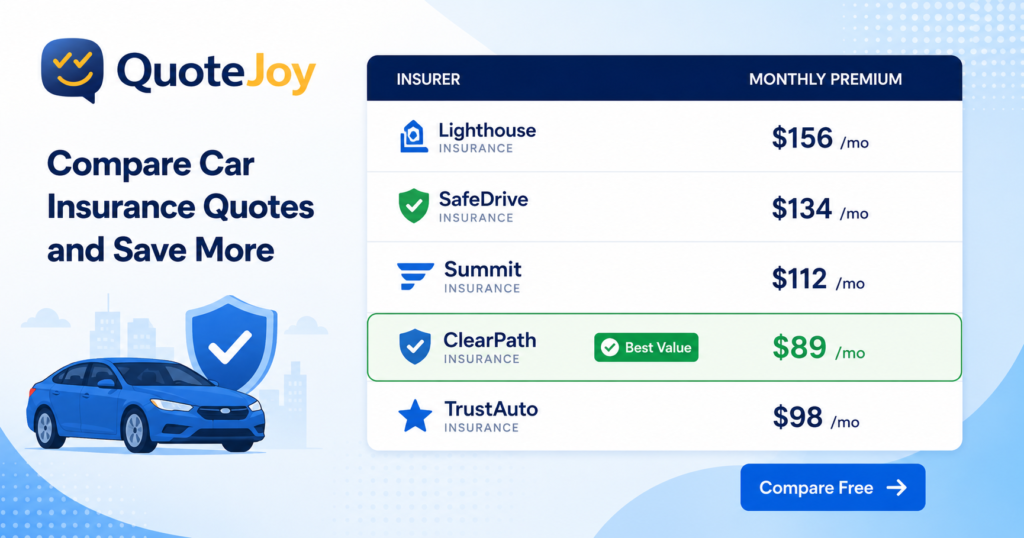
First, gather your driver’s license number, vehicle identification number (VIN), an estimate of your annual mileage, and details of any prior policy. Next, visit a quote-comparison platform that pulls offers from multiple carriers at once this is the core service offered through QuoteJoy’s auto insurance platform, where verified agencies compete for your business in real time. Then, request the same coverage limits from every carrier so the prices are genuinely comparable: mismatched deductibles or liability limits will distort what looks “cheapest.†Finally, ask each carrier about every discount you might qualify for before you accept a final number.
When you compare car insurance quotes online free, you are leveraging the single mechanism that gives consumers the most leverage in the entire auto insurance market.
Discounts Every New Driver Should Claim
The fastest route to cheap auto insurance quotes is layering discounts. Most major carriers offer several that new drivers routinely overlook.
A good-student discount can save up to 25% if you maintain a B average or better. Driver’s education completion can shave another 5–15% off your premium with most carriers. Defensive-driving courses approved by your state DMV often deliver an additional discount that lasts three years.
Telematics or usage-based programs (such as Drivewise, Snapshot, or SmartRide) reward safe driving habits and can cut premiums 10–30% after the monitoring period. Multi-policy bundling combining auto with renters or home insurance typically saves another 10–25%. Finally, paying in full instead of monthly installments and choosing paperless billing routinely lower your premium by a small but meaningful amount.
Should You Stay on a Parent’s Policy?
For new drivers under 25 living at home, staying on a parent’s full-coverage policy is almost always cheaper than buying a stand-alone policy. Industry analysis shows the average 16-year-old male pays roughly $10,638 per year on a standalone policy, versus an effective $3,403 per year as an addition to a family plan a savings of nearly 68%. The exceptions are when a new driver lives at a different permanent address, owns the vehicle outright as the named insured, or when adding them would push the household into a higher risk tier.
Why QuoteJoy Helps New Drivers Save
QuoteJoy connects new drivers with verified independent agencies that compete to deliver affordable auto insurance built around your actual profile, not a generic average. Our partner network spans full-coverage, liability-only, and high-risk specialty markets, so you see realistic offers from carriers that genuinely want your business. Drivers who use QuoteJoy frequently lock in coverage in under 10 minutes, often at a noticeably lower rate than they had before.
If you are ready to find the cheapest car insurance for new drivers in your state, head over to our auto insurance comparison page and start your free quote in under 90 seconds no obligation, no spam, no surprises. You can also bundle with home insurance or life insurance to unlock additional multi-policy savings.
The Bottom Line
The cheapest car insurance for new drivers in 2026 is not hiding from you. It is simply waiting on the other side of a real comparison. Pull quotes from at least three carriers, request every discount you qualify for, and re-shop your policy at every renewal. New drivers who follow this short checklist save hundreds of dollars per year and that is money far better spent on fuel, maintenance, or the down payment on your next car.
Ready to start saving? Get your free QuoteJoy auto insurance quote now or contact our team for a personalized review.
Frequently Asked Questions (FAQs)
GEICO and National General offer the cheapest car insurance for new drivers in 2026, averaging around $4,030 per year nationally. USAA is cheapest for military families, while State Farm leads on good-student discounts. Compare quotes through QuoteJoy to find your lowest rate.
Car insurance for a new driver costs an average of $176 to $400 per month for full coverage in 2026. Drivers under 25 pay around $289 per month on average, while drivers over 25 pay closer to $155 per month for liability-only coverage.
New drivers need full coverage only if they finance or lease their vehicle, or if their car is worth more than about $4,000. If you own an older car outright, liability-only coverage is usually enough and meaningfully cheaper.
It is almost always cheaper to add a new driver to a parent’s policy than to buy a standalone one, with average savings of 65–68%. A separate policy only makes sense if the new driver lives at a different address or owns the vehicle outright.
New drivers can stack good-student (up to 25%), driver’s education (5–15%), telematics (10–30%), and multi-policy bundling (10–25%) discounts. Always ask each carrier which discounts apply before accepting a final quote.