


If your roof is leaking, missing shingles, or showing dents the size of golf balls after a storm, the very first question on most homeowners’ minds is the same: will my insurance pay for this? After nearly a decade adjusting residential property claims, I can tell you the honest answer is “sometimes” and the difference between “covered” and “denied” usually comes down to two things most policyholders never check until it is too late: the cause of damage, and which payout method your policy uses.
This guide walks through exactly when a standard U.S. homeowners policy will pay for a new roof, when it will not, and the specific moves that improve your odds of a full replacement check in 2026.
The Short Answer
A standard HO-3 homeowners insurance policy the type most Americans hold will pay to repair or replace your roof when the damage was sudden, accidental, and caused by a covered peril. It will not pay when the damage came from age, wear and tear, neglect, or maintenance issues. That single distinction explains roughly 80% of the roof claim denials I see.
Covered Causes of Roof Damage
Most homeowners policies cover roof damage from the following named perils. Specific exclusions vary by carrier and state, so always read the declarations page, but these are the consistent inclusions across major U.S. insurers in 2026:
- Wind and windstorm damage (lifted, torn, or missing shingles after a storm)
- Hail damage (denting, granule loss, cracked shingles)
- Falling objects most commonly tree limbs during storms
- Fire and smoke damage
- Weight of ice, snow, or sleet causing structural roof failure
- Sudden and accidental damage from vandalism
- Lightning strikes
What Is Almost Always Excluded
Roof claims are denied more often than any other category in homeowners insurance. The reasons cluster into a predictable list, and any one of them can void the claim entirely:
- Age-related deterioration (curling shingles, granule loss from sun exposure)
- Lack of maintenance (clogged gutters causing rot, moss buildup, sagging from ignored leaks)
- Pre-existing damage the carrier finds on inspection photos
- Damage from pests, rodents, or insects
- Manufacturer defects in the roofing material (these go to the product warranty, not the insurer)
- Flood damage from rising water covered only by a separate flood policy
- Earth movement and earthquake (also separate policies)
The Age-of-Roof Factor Most People Miss
Even when damage is from a clearly covered peril, the age of your roof can change how or whether your insurer pays. Most U.S. carriers in 2026 do one of three things once a roof passes 15–20 years of age:
First, they may continue to provide Replacement Cost Value (RCV) coverage, which pays the full cost of a new roof minus your deductible. This is the best-case scenario.
Second, they may automatically convert your roof coverage to Actual Cash Value (ACV), which subtracts depreciation from the payout. On a 22-year-old asphalt roof, ACV can mean a payout of $3,000 against a $15,000 replacement bill leaving the homeowner to cover the rest.
Third, some insurers exclude roof coverage entirely once shingles pass a stated age. This is most common in hail-prone states like Texas, Colorado, and Oklahoma, where some carriers cap roof coverage at 15 years.
Before your next renewal, find the line on your declarations page that says either “RCV” or “ACV” next to dwelling or roof coverage. If you cannot find it in 60 seconds, call the carrier and ask directly. Knowing this single piece of information changes how you should approach any future claim.
RCV vs ACV: A Real Number Example
| Payout Method | Roof Replacement Cost | Depreciation Applied | Deductible | Your Net Payout |
|---|---|---|---|---|
| RCV (Replacement Cost) | $18,000 | $0 | $2,000 | $16,000 |
| ACV (Actual Cash Value, 18-yr roof) | $18,000 | $10,800 (60%) | $2,000 | $5,200 |
| ACV (Actual Cash Value, 8-yr roof) | $18,000 | $4,500 (25%) | $2,000 | $11,500 |
These figures are illustrative but reflect typical 2026 depreciation tables used by major U.S. carriers for asphalt shingle roofs. Tile and metal roofs depreciate more slowly. For a deeper breakdown of payout methods, see our explainer on
replacement cost vs actual cash value start with our RCV vs ACV guide before you renew, especially if your roof is over 10 years old.
How to File a Roof Replacement Claim (Step by Step)
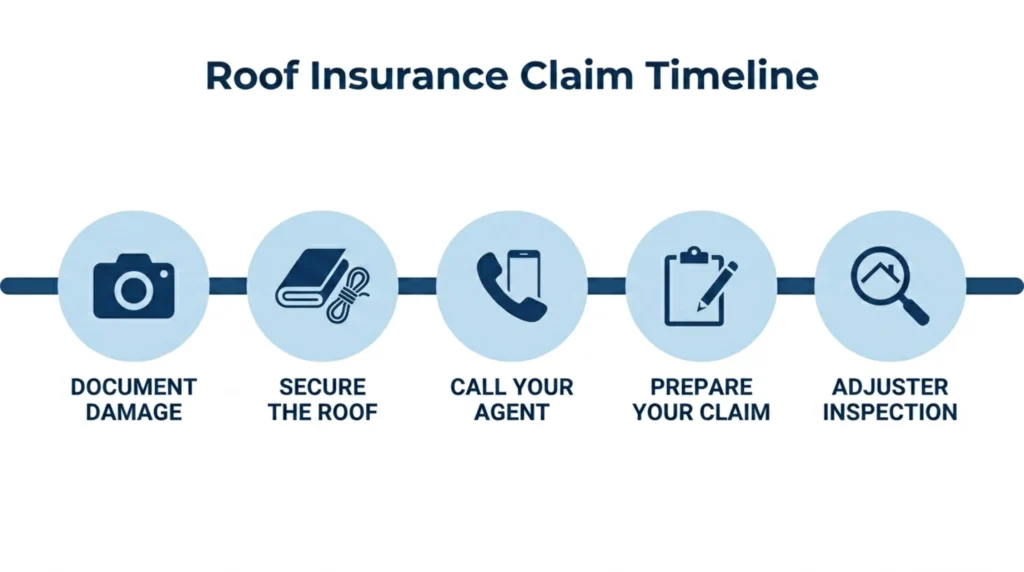
The strength of your claim is built in the first 72 hours after damage. Follow this sequence and your odds of approval and a full payout go up significantly.
Step 1: Document everything before touching the roof
Take dated photos and videos from multiple angles before any cleanup. Capture missing shingles, debris on the ground, hail marks on cars and gutters, and any interior water staining. Save weather reports for the storm date the National Weather Service archive is free and admissible.
Step 2: Make temporary repairs to prevent further damage
Your policy obligates you to mitigate ongoing damage. Tarping a hole, covering a window, or moving belongings out of a wet room is required. Keep receipts — these are reimbursable. Do not begin permanent repairs until the adjuster has inspected.
Step 3: Call your insurer, not the contractor first
The order matters. Some carriers void claims where work began before the adjuster’s inspection. Be factual on the call: give the date, peril, and visible damage. Avoid speculating about cause.
Step 4: Get an independent roofer’s estimate
Always obtain at least one estimate from a licensed local roofer before the adjuster’s visit. This becomes your baseline for negotiating the scope of work. Adjusters write conservative scopes by default an independent estimate flags items they missed.
Step 5: Read the adjuster’s report line by line
If the report excludes items the roofer identified, you have the right to request a supplemental claim with documentation. About 30% of supplemental claims are approved in full or in part. Do not skip this step.
How Much Does a Roof Claim Raise Your Premium?
One roof claim filed for a clearly covered peril typically raises premiums 5–10% at the next renewal, and that surcharge usually drops off after 3–5 years. Two or more property claims within five years is where premiums climb sharply and where the risk of non-renewal becomes real. For a single legitimate roof claim worth several thousand dollars, the math almost always favors filing.
How Strong Is Your Roof Coverage Today?
The single most important sentence on your homeowners declarations page is the one that says “RCV” or “ACV.” If you have not checked it, do that today. Then use our free home insurance comparison tool to see whether better roof coverage is available in your state especially if your roof is 10+ years old or you live in a hail or hurricane zone. While you’re tightening up your home policy, our home and auto bundle guide shows how to layer a bundle discount on top.
How This Article Was Researched
Coverage rules cited here are based on the standard ISO HO-3 homeowners policy form, supplemented by state insurance department bulletins and 2025 claims data from the National Association of Insurance Commissioners (NAIC). Specific exclusions vary by carrier and state always read your own policy. QuoteJoy does not accept payment from any insurance carrier in exchange for favorable mentions.
Frequently Asked Questions (FAQs)
Sometimes. If matching shingles are no longer manufactured or available, many states have “matching laws” that require the insurer to replace the full roof. Texas, Florida, and several others have explicit matching statutes. Always raise this point before accepting a partial-slope payout.
Most policies require notice “promptly” after damage, and most state statutes of limitation allow 1–2 years from the date of loss. Waiting weakens the claim — the longer you wait, the easier it is for an adjuster to argue the damage came from a later, uncovered event.
A single legitimate claim almost never triggers non-renewal. A pattern of multiple property claims within 3–5 years can. If you are uncertain whether a claim is worth filing, get a contractor’s estimate first if the cost is under your deductible plus expected premium increase, paying out of pocket may be smarter.