

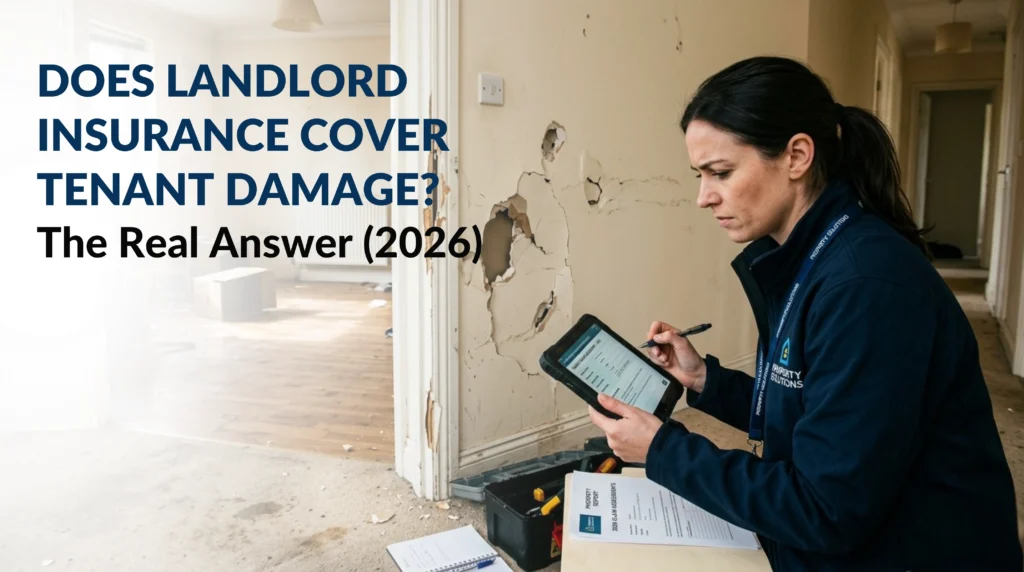
It’s the question almost every U.S. landlord asks eventually usually while standing in a freshly vacated unit, staring at damage that wasn’t there at move-in. Does your landlord insurance actually pay for what a tenant did to your property? The honest, complete answer is: it depends entirely on what kind of damage it is.
Sudden, accidental damage from a covered peril is often paid for. Slow leaks, neglect, ordinary wear, and deliberate destruction usually are not at least not without a specific add-on.
That “it depends” is exactly where American landlords lose thousands of dollars: they assume their policy is a catch-all for anything a tenant does, file a claim, and get denied. This guide draws the line precisely for U.S. rental owners, with real-world examples, a clear coverage table, and the three-layer strategy that actually protects you. By the end, you’ll know what to claim, what to handle with a security deposit, and what to add to your policy before you ever need it.
(One note up front: landlord-tenant and security-deposit rules vary by state from California to Texas to New York so always check your local statute for deposit limits and timelines.)
The short answer: it depends on the type of damage
Landlord insurance in the U.S. typically covers sudden, accidental damage caused by a covered peril even when a tenant triggered it. It generally does not cover normal wear and tear, gradual damage from neglect, or intentional and malicious destruction.
Some insurers sell optional coverage for malicious tenant damage, but it is rarely included automatically on a standard American landlord (often called a “dwelling fire” or DP-3) policy.
To make this crystal clear, here’s how the three broad categories of tenant-related damage are usually treated:
| Type of damage | Typically covered? | Why |
|---|---|---|
| Sudden & accidental (e.g. tenant starts a kitchen fire) | Usually YES | Caused by a covered peril like fire or sudden water damage |
| Wear and tear (worn carpet, scuffs, faded paint) | NO | Considered the ordinary cost of owning a U.S. rental |
| Gradual damage / neglect (slow leak, mold from poor ventilation) | NO | Built up over time rather than a sudden event |
| Intentional / malicious (tenant deliberately trashes the unit) | Only with an add-on | Standard U.S. policies often exclude it; an endorsement is needed |
| Tenant’s own belongings | NO | Covered by the tenant’s renters insurance, not yours |
Now let’s break each of these down with examples, so you know exactly where your policy stands.
What landlord insurance usually DOES cover
The unifying theme of covered tenant damage is that it’s sudden and accidental, and it stems from a peril your policy already protects against. In these cases, the fact that a tenant was involved doesn’t change anything your dwelling coverage pays to repair the building, minus your deductible (commonly $1,000–$2,500 on U.S. landlord policies).
1. Accidental fire
A tenant leaves a pan unattended and starts a kitchen fire that scorches the cabinets and walls. Fire is a covered peril on virtually every U.S. landlord policy, so the structural damage is generally covered. If repairs run, say, $18,000 and your deductible is $1,500, the insurer covers roughly $16,500. This is one of the clearest examples of “tenant-caused but still covered.”
2. Sudden water damage
A tenant accidentally leaves a faucet running or a washing-machine hose bursts, flooding the bathroom and damaging the floor below. Sudden, accidental water damage is typically covered. The key word is sudden a slow leak the tenant ignored for weeks usually is not (more on that below). Note that flooding from outside (storm surge, overflowing rivers) is excluded everywhere in the U.S. and requires separate FEMA/NFIP flood insurance.
3. Accidental appliance or system malfunction
An appliance malfunctions and causes sudden damage to the structure for example, an overflow or a sudden pipe failure. The resulting structural damage is often covered, though the appliance itself may not be.
In all three cases, you pay your deductible and the insurer covers the rest of the structural repair. Importantly, after paying, you may be able to recover your deductible from the tenant or the tenant’s renters insurance if they were at fault a process U.S. insurers call subrogation.
What landlord insurance usually does NOT cover
This is where landlords get blindsided. Four categories are commonly excluded from a standard U.S. policy.
1. Normal wear and tear
Worn carpet, scuffed walls, faded paint, small nail holes, and lightly stained grout are all considered normal wear and tear — the ordinary, expected cost of renting out a property. Insurance never covers these, because they aren’t “damage” in the policy sense; they’re depreciation. This is precisely what a security deposit exists to handle, and most state laws explicitly bar landlords from deducting normal wear and tear from a deposit.
2. Gradual damage and neglect
A slow leak the tenant ignored for months, mold from chronic poor ventilation, rot from deferred maintenance, or pest damage that built up over time are typically excluded. U.S. policies cover sudden events, not problems that develop slowly. If a tenant fails to report a small leak and it quietly rots a subfloor over a year, that’s usually on you not the insurer.
3. Intentional or malicious damage (unless you add coverage)
This is the classic American landlord nightmare: a disgruntled tenant punches holes in the drywall, smashes fixtures, pours concrete down a drain, or deliberately trashes the unit on the way out. Standard U.S. landlord policies frequently exclude intentional and malicious damage. However and this is the crucial part many insurers offer optional “malicious tenant damage” or “vandalism by tenant” coverage as an endorsement, often for a modest premium increase. If this risk worries you, ask for it specifically. Do not assume it’s built in.
4. The tenant’s own belongings
Your landlord policy never covers the tenant’s furniture, electronics, clothing, or other possessions. Those are the tenant’s responsibility, which is exactly why you should require renters insurance in the lease (covered below) a clause that is fully legal and standard across the U.S.
Tenant damage vs. wear and tear: where’s the line?
Because wear and tear is excluded but real damage may be claimable and because the distinction also governs what you can legally deduct from a security deposit under your state’s law — knowing the difference matters. Here’s a practical comparison:
| Normal wear and tear (your cost) | Tenant damage (claimable / deductible) |
|---|---|
| Faded paint or lightly scuffed walls | Large holes punched in drywall |
| Worn or matted carpet from normal use | Carpet burns, pet stains, or rips |
| Loose door handles or hinges over time | Doors kicked in or torn off |
| Minor nail holes from hanging pictures | Broken windows or smashed fixtures |
| Lightly worn countertops | Deep gouges, burns, or cracks from misuse |
A useful rule of thumb used by U.S. property managers: wear and tear is what happens when a careful tenant simply lives in the unit; damage is what happens through negligence, accident, or intent. For a fuller picture of everything a landlord policy includes beyond tenant damage, see our complete breakdown of what landlord insurance actually covers.
The three-layer safety net against tenant damage
Smart U.S. landlords don’t rely on insurance alone. The most resilient approach stacks three layers, each handling a different slice of risk and using them in the right order saves your policy for when it truly matters.
Layer 1: The security deposit
Your first line of defense for minor damage and disputes over wear and tear. Document the unit’s condition thoroughly with dated photos and video at both move-in and move-out. A clear record is what lets you fairly and legally deduct for genuine damage and protects you if the tenant disputes it. Remember that most states cap the deposit (often one to two months’ rent) and set strict deadlines (commonly 14–30 days) to return it with an itemized list of deductions, so follow your state’s rules precisely.
Layer 2: The tenant’s renters insurance
Require it in every lease. If a tenant accidentally causes damage say that kitchen fire or overflow their renters policy’s liability coverage may pay for it, which protects your deductible and keeps a claim off your record. Renters insurance is inexpensive in the U.S. (frequently $15–$25 a month), so requiring it is one of the highest-value, lowest-friction lease clauses an American landlord can add.
Layer 3: Your landlord policy
The backstop for major, sudden, accidental damage from covered perils — the fire that guts a kitchen, the burst pipe that floods two floors. Most U.S. landlord policies also include fair rental value (loss of rent) coverage, which replaces the income you lose while the unit is being repaired after a covered loss. This is the layer you protect by handling smaller issues with the first two layers.
Used together, these three layers cover the overwhelming majority of realistic tenant-damage scenarios faced by U.S. rental owners.
Should you file a claim for tenant damage or not?
Even when damage is covered, filing isn’t always the smart move. Like any insurance claim in the U.S., a tenant-damage claim can raise your premium and goes on your CLUE (Comprehensive Loss Underwriting Exchange) report, which insurers review when pricing your renewal. For smaller losses, it’s often cheaper in the long run to use the security deposit or pursue the tenant’s renters insurance rather than file.
Run this quick mental checklist before filing:
- Is the repair cost meaningfully higher than my deductible? (If a $1,200 repair sits just above a $1,000 deductible, paying out of pocket is usually better.)
- Can the security deposit or the tenant’s renters insurance cover it instead?
- How many claims have I filed recently? (Frequent claims trigger rate hikes or non-renewal in the U.S.)
- Is this a major structural loss? (If yes, that’s exactly what the policy is for — file it.)
Saving your policy for genuinely large losses keeps your long-term premiums down and reduces the risk of non-renewal.
How to protect yourself from tenant damage (before it happens)
Prevention and preparation beat any claim. These steps dramatically reduce both the odds and the cost of tenant damage for U.S. landlords:
- Require renters insurance in every lease. It shifts accidental-damage risk to the tenant’s policy and gives you another party to recover from a legal, standard practice nationwide.
- Document everything. Time-stamped photo and video walkthroughs at move-in and move-out settle disputes and support both deposit deductions and insurance claims, and they hold up if a dispute reaches small-claims court.
- Screen tenants carefully. Background, credit, income, and reference checks (within Fair Housing rules) are the single best defense against malicious damage because the best protection is choosing reliable tenants in the first place.
- Add malicious-damage coverage if your property type, location, or tenant turnover makes deliberate damage a real risk.
- Do regular, lease-permitted inspections. Most states require advance notice (often 24–48 hours); catching a small leak early prevents the slow, uncovered damage that policies exclude.
- Carry strong liability coverage too. Tenant damage to your building is one risk; a tenant or guest being injured and suing you is a far larger one. A landlord umbrella insurance policy adds an extra $1 million or more of liability protection on top of your base coverage valuable in a litigious U.S. environment.
Does homeowners insurance cover tenant damage instead?
No and this is a costly trap for new U.S. landlords. A standard homeowners (HO-3) policy excludes rental activity. The moment you rent the property out, your homeowners insurer can deny landlord-related claims, including tenant damage, because the home is no longer being used the way the policy assumes.
If you’re renting out a property anywhere in the U.S., you need an actual landlord policy (such as a DP-3, or an HO-6-based policy for a rented condo); trying to save money by keeping a homeowners policy on a rental usually means no coverage at all when you need it.
Frequently asked questions
Usually yes, if the damage is sudden and caused by a covered peril such as an accidental fire or a sudden burst pipe. Your dwelling coverage pays for the structural repair minus your deductible. Gradual damage and ordinary wear and tear are not covered on U.S. policies
Not by default. Most standard U.S. policies exclude intentional and malicious damage. However, many insurers offer an optional “malicious tenant damage” or “vandalism by tenant” endorsement you can add for a modest premium. If deliberate damage is a concern, ask your insurer to include it specifically.
Wear and tear is the gradual, expected deterioration from ordinary living faded paint, worn carpet, minor nail holes and is never covered or legally deductible from a deposit. Tenant damage is the result of accident, negligence, or intent holes in walls, carpet burns, broken fixtures and may be claimable or deductible under your state’s security-deposit law.
Yes, but they cover different things. The security deposit is best for minor damage and wear-and-tear disputes (within your state’s limits); insurance is for major sudden losses. For small repairs, using the deposit (or the tenant’s renters insurance) avoids a claim that could raise your premium or hit your CLUE report.
It can. Claims go on your CLUE history and may increase your renewal premium or even lead to non-renewal especially if you file frequently. For losses only slightly above your deductible, paying out of pocket or using the deposit is often cheaper over time. Reserve claims for large structural losses.
It can. If a tenant accidentally damages your building, their renters policy’s liability coverage may pay for it which is why requiring renters insurance in the lease is so valuable across the U.S. It can protect your deductible and keep a claim off your record.
No. U.S. homeowners (HO-3) policies exclude rental use, so claims on a rented-out property can be denied. Once you rent the home, you need a dedicated landlord policy (such as a DP-3) to be covered for tenant damage and other rental risks.
The bottom line
Landlord insurance in the U.S. covers sudden, accidental tenant-caused damage from covered perils fire, sudden water damage, and the like but not normal wear and tear, gradual neglect, or (without an add-on) intentional destruction.
Protect yourself with the three-layer strategy: a documented security deposit for minor issues (within your state’s rules), mandatory tenant renters insurance for accidental damage, and your landlord policy as the backstop for major losses.
Add a malicious-damage endorsement if your risk warrants it, and never assume a homeowners policy will step in.
Want coverage that actually matches your rental’s real risks? Compare landlord insurance quotes on QuoteJoy and see exactly what’s covered before you ever need to file. You can also start a landlord insurance quote here, or reach our team with any coverage questions.