

If you’ve just started renting out a property in the U.S. or you’re running the numbers before you buy one one question comes up fast: how much is landlord insurance going to cost me? It’s an unavoidable cost of owning an American rental, and it’s almost always a little more expensive than the homeowners policy you’d carry on a home you actually live in.
The good news is that the price is far more controllable than most landlords realize, once you understand what drives it.
In this guide you’ll get realistic U.S. cost ranges for 2026, a clear breakdown of the seven factors that move your premium up or down, how prices differ from state to state, the levers you can pull to lower it, and answers to the questions American landlords ask most. We’ll keep the numbers honest: actual prices vary widely by property and location, so treat every figure here as an illustrative range the only way to get your true number is to compare real quotes.
How much does landlord insurance cost on average in the U.S.?
Landlord insurance generally costs about 15% to 25% more than a comparable homeowners policy on the same property.
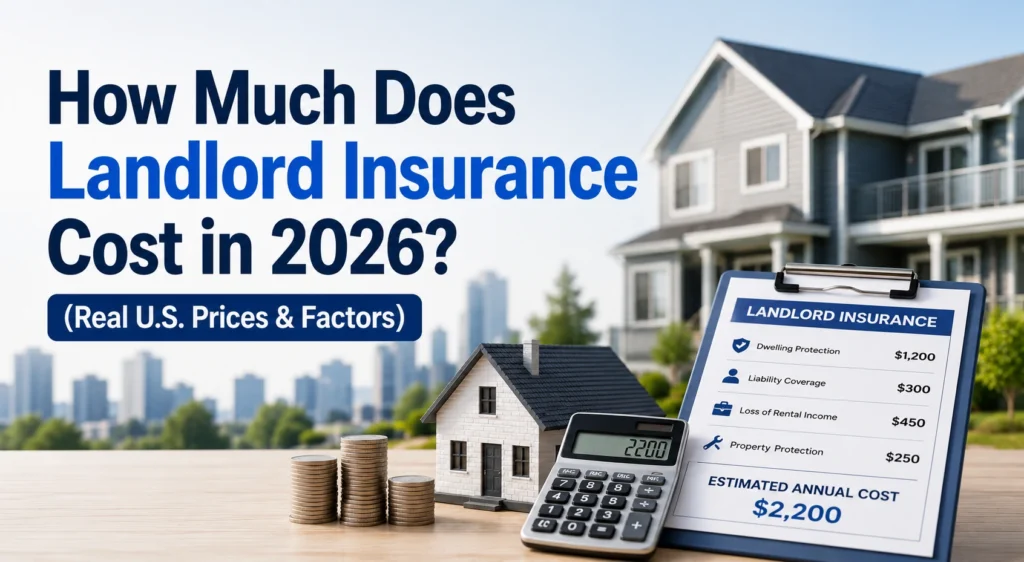
In dollar terms, many U.S. landlords pay somewhere in the range of $1,200 to $2,500 per year for a single-family rental roughly $100 to $210 per month though high-cost coastal states can run well above that and low-risk inland areas well below it.
Because the dollar figure swings so much by location and property type, the percentage difference from a standard home policy is often the more useful benchmark. Here’s an illustrative look at how monthly costs tend to line up by property type (U.S. averages, not guaranteed quotes):
| Property type | Illustrative annual range* | Main cost driver |
|---|---|---|
| Condo rental (HO-6 style) | $700 – $1,300 | HOA master policy covers the building shell |
| Single-family rental | $1,200 – $2,500 | Straightforward but full-structure risk |
| Duplex / small multi-unit | $1,800 – $3,500 | More units = more exposure |
| Older or coastal property | $2,500 – $5,000+ | Age, roof, and catastrophe risk |
*Illustrative U.S. ranges for 2026; your actual premium depends on the factors below. Always compare real quotes.
What’s included in that cost?
When you pay a U.S. landlord insurance premium, you’re buying a bundle of coverages typically packaged as a DP-1, DP-2, or (most commonly and most comprehensive) a DP-3 “dwelling fire” policy:
- Dwelling coverage: repairs or rebuilds the structure after a covered event (fire, storm, etc.). This is the largest part of your premium. A DP-3 covers it at replacement cost; cheaper DP-1 policies pay only actual cash value.
- Liability coverage: protects you if a tenant or guest is injured on the property. See our full guide to what landlord insurance covers for how this fits in.
- Fair rental value (loss of rent): replaces rental income if the property becomes uninhabitable after a covered loss, usually for up to 12 months.
- Other structures: fences, sheds, detached garages.
Add-ons like NFIP flood insurance (required in FEMA flood zones), vandalism beyond the base, or coverage for landlord-owned contents (appliances, furnishings in a furnished rental) increase the price.
And remember that tenant damage is only partly covered see does landlord insurance cover tenant damage for exactly where the line is.
7 factors that drive your landlord insurance cost
1. Location and state
The biggest factor by far. Properties in U.S. states prone to hurricanes (Florida, Louisiana, Texas Gulf Coast), wildfires (California), or hail and tornadoes (Oklahoma, Kansas) cost dramatically more to insure. A rental in a low-risk inland state like Ohio or Indiana can cost a fraction of an identical one on the Florida coast sometimes less than half.
2. Property type and size
A single-family home, a duplex, and a multi-unit building all carry different risk profiles. More units generally means more premium. Condos are often cheapest because the HOA’s master policy covers the building exterior, leaving you a smaller HO-6-style policy.
3. Age and condition of the building
Older U.S. homes older roofs, knob-and-tube or aluminum wiring, galvanized plumbing cost more to insure because they’re more likely to suffer (and cause) damage. Many carriers surcharge or decline roofs older than 20 years.
4. Coverage limits and deductible
Higher dwelling and liability limits raise the premium; a higher deductible lowers it. Raising your deductible from $1,000 to $2,500, for instance, can cut your premium noticeably. Choosing replacement-cost coverage (DP-3) over actual cash value (DP-1) costs more but pays out far better after a claim.
5. Rental type
A long-term lease is cheaper to insure than a short-term or vacation rental (think Airbnb or VRBO), which U.S. insurers view as higher-turnover and higher-risk and often require a special endorsement or commercial policy for.
6. Your claims history
A track record of frequent claims visible to insurers on your CLUE report raises your rate or can lead to non-renewal. A clean history helps keep it low.
7. Safety features and credit
Smoke detectors, monitored alarms, updated roofs, and deadbolts can earn discounts. In most states, a stronger credit-based insurance score also lowers your premium (though states like California, Maryland, and Massachusetts restrict its use).
How landlord insurance cost varies by state
Because insurance is regulated state by state in the U.S. and catastrophe risk differs enormously, the same rental can cost wildly different amounts depending on where it sits. Illustrative directional ranges:
| State / region | Relative cost | Why |
|---|---|---|
| Florida & Gulf Coast | Highest | Hurricane and flood exposure |
| California | High | Wildfire risk; specialty markets |
| Texas | Above average | Hail, tornado, and coastal storms |
| Midwest (OH, IN, IL) | Below average | Lower catastrophe risk |
| Inland low-risk states | Lowest | Minimal natural-disaster exposure |
This is exactly why comparing quotes matters so much: a carrier that’s competitive in one state may be expensive in another.
How to lower your landlord insurance cost
You can’t change the property’s ZIP code, but U.S. landlords can control several levers:
- Raise your deductible. Going from a $1,000 to a $2,500 deductible can meaningfully cut your premium if you can cover the higher out-of-pocket amount after a loss.
- Bundle policies. Insuring multiple rentals or your rental plus your own home and auto — with one carrier often unlocks a multi-policy discount.
- Improve the property. A new roof, updated electrical and plumbing, and security features reduce risk and premium, and may be required for coverage on older U.S. homes.
- Require tenant renters insurance. Making it a lease requirement shifts some risk off your policy and signals lower risk to insurers.
- Maintain a clean CLUE record. Avoid filing small claims you could pay out of pocket; reserve claims for major losses.
- Shop and compare. The single biggest lever. U.S. landlord insurance pricing varies dramatically between carriers for the exact same property.
Is landlord insurance worth the cost?
For almost every U.S. rental owner, yes and it’s usually required by your mortgage lender anyway. The alternative is paying out of pocket for a fire, a storm, a liability lawsuit, or months of lost rent. A single uncovered event can wipe out years of rental profit; a kitchen fire alone can run $20,000 to $50,000 in structural repairs. The premium is a small, predictable cost that protects against rare but financially devastating ones.
What you should not do is try to insure a rental under a standard homeowners (HO-3) policy to save money. U.S. homeowners insurance excludes rental activity, so a claim on a property you rent out can be denied outright leaving you with the full cost and no coverage.
Landlord insurance vs. other insurance costs
To put the price in perspective against related U.S. coverages many landlords also carry:
- Homeowners insurance: The baseline; landlord coverage runs about 15–25% higher.
- Umbrella insurance: Surprisingly cheap for the protection; the first $1 million often costs only a few hundred dollars a year. See our breakdown of umbrella insurance cost.
- Flood insurance (NFIP) A separate policy required in FEMA flood zones, priced by flood risk, not bundled into your landlord premium.
Frequently asked questions about landlord insurance cost
Most U.S. landlords pay roughly $100 to $210 per month for a single-family rental, or about $1,200 to $2,500 per year. Condos are often cheaper and older or coastal properties more expensive. Your exact cost depends on location, property type, coverage limits, and deductible.
Landlord insurance costs about 15–25% more because insurers see rentals as higher-risk: more occupant turnover, tenants who may not maintain the property like an owner, added liability exposure, and the inclusion of loss-of-rent coverage that homeowners policies don’t have.
Yes. Older U.S. homes with aging roofs, knob-and-tube or aluminum wiring, and outdated plumbing cost more to insure, and many carriers surcharge or decline roofs older than about 20 years. Updating these systems can lower your premium.
Generally yes. In the U.S., landlord insurance premiums are typically a deductible business expense on Schedule E of your federal tax return, since the rental is income-producing property. Confirm with a tax professional for your situation.
Raise your deductible, bundle multiple policies with one carrier, improve the property (new roof, updated systems, security devices), require tenant renters insurance, keep a clean claims (CLUE) record, and most importantly compare quotes from several carriers, since pricing varies widely.
Most U.S. landlord policies include fair rental value (loss of rent) coverage, which replaces your rental income if the property becomes uninhabitable after a covered loss, typically for up to 12 months. It’s one reason landlord insurance costs more than homeowners coverage.
No U.S. state legally mandates landlord insurance the way auto insurance is required. However, mortgage lenders almost always require it as a condition of the loan, and going without it leaves you personally exposed to fire, storm, liability, and lost-rent losses.
Conclusion
Expect landlord insurance in the U.S. to cost roughly 15–25% more than a homeowners policy on the same property commonly $1,200 to $2,500 a year for a single-family rental with location and state, property type, age, and coverage limits driving the final number. You can lower it by raising your deductible, bundling, improving the property, keeping a clean claims record, and, most importantly, comparing quotes.
Want a real number for your property? Compare landlord insurance quotes on QuoteJoy and see pricing from top U.S. carriers side by side. You can start a landlord insurance quote here, or contact our team if you’d like help choosing limits.