


Choosing between term and whole life insurance is one of the most consequential financial decisions an American family makes yet most people pick the wrong policy because they’re sold the more expensive option first. According to LIMRA’s 2025 Insurance Barometer Study, 52% of US adults own life insurance, but nearly half admit they’re either underinsured or don’t fully understand what they bought.
Here’s the truth in plain English: term life insurance is rented protection that’s cheap and simple, while whole life insurance is owned protection that’s expensive but lasts forever and builds cash value. Neither is universally “better” the right answer depends on why you need coverage in the first place. This guide breaks down the real differences using 2026 US pricing data, explains how each policy is regulated, and helps you decide which one fits your family in under seven minutes.
What you’ll learn in this guide
- How life insurance actually works in the United States
- Side-by-side comparison: term vs. whole life with real 2026 prices
- Tax rules, regulation (NAIC, state DOI), and the contestability period
- How much coverage you really need and which policy type fits
- State-specific notes for Texas, Florida, and California buyers
How life insurance works in the United States
Life insurance is a contract between you (the policyholder) and a state-licensed insurance carrier. You pay a monthly or annual premium; in exchange, the carrier promises to pay a tax-free death benefit to your named beneficiary if you die while the policy is active. That’s the entire product in one sentence everything else is a variation on those mechanics.
Every US life insurance policy goes through underwriting, the process by which the carrier evaluates your age, health, lifestyle, occupation, and family medical history to assign you a rate class (Preferred Plus, Preferred, Standard, or substandard table ratings). The healthier you are at application, the lower your premium and once your rate class is locked in, it generally doesn’t change for the life of the policy.
Life insurance in the US is regulated at the state level by each state’s Department of Insurance, with model laws coordinated through the National Association of Insurance Commissioners (NAIC). Federally, the Internal Revenue Code Section 7702 defines what qualifies as life insurance for favorable tax treatment which is why death benefits to your beneficiaries are generally received income-tax-free.
What is term life insurance?
Term life insurance covers you for a fixed period typically 10, 15, 20, 25, or 30 years. If you die during the term, your beneficiary receives the death benefit. If you outlive the term, the coverage simply expires (most term policies are convertible to permanent coverage, though, without new underwriting).
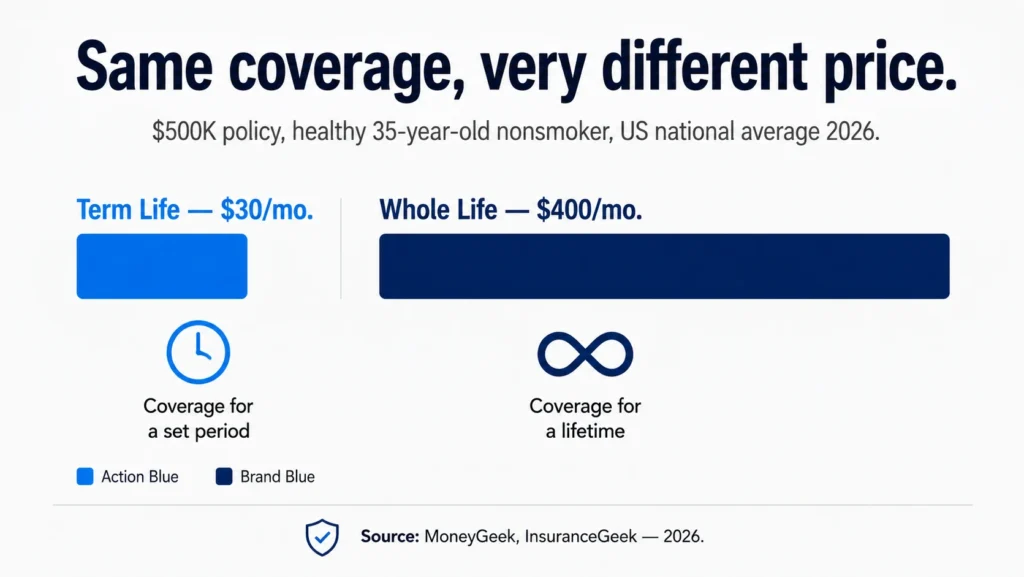
It’s the cheapest form of life insurance because it has no investment component and most policies never pay out only about 1% to 2% of term policies result in a death claim, which is why carriers can price them so aggressively. According to 2026 data from MoneyGeek and InsuranceGeek, a healthy 35-year-old nonsmoker in the US pays roughly $25 to $40 per month for a $500,000, 20-year term policy. The same coverage at age 50 jumps to about $150 per month — which is exactly why buying young matters.
What is whole life insurance?
Whole life insurance is permanent it covers you for your entire lifetime as long as premiums are paid. It costs significantly more than term because part of every premium dollar goes into a cash value account that grows tax-deferred at a guaranteed rate (typically 2% to 4%) and may earn additional non-guaranteed dividends if you buy from a mutual carrier like Northwestern Mutual or MassMutual.
That cash value is yours. You can borrow against it, withdraw it, or surrender the policy for its accumulated value. According to 2026 InsuranceGeek and MoneyGeek data, whole life runs roughly 10 to 22 times more expensive than term for the same death benefit. A healthy 35-year-old who pays $30 a month for $500,000 in term coverage would pay $300 to $500 a month for the same face amount in whole life.
Term vs. whole life: side-by-side comparison
Here’s how the two products stack up on the factors that matter most to US buyers in 2026:
| Feature | Term Life Insurance | Whole Life Insurance |
|---|---|---|
| Coverage length | 10, 15, 20, 25, or 30 years | Lifetime (as long as premiums paid) |
| Avg. cost (healthy 35-yr-old, $500K) | $25–$40 / month | $300–$500 / month |
| Cash value | None | Yes — grows tax-deferred |
| Premium stability | Level for the term | Level for life |
| Death benefit tax | Income-tax-free | Income-tax-free |
| Best for | Income replacement, mortgage protection, raising kids | Estate planning, lifetime dependents, business succession |
| Renewable / convertible | Usually yes, until age 65–70 | Not applicable (already permanent) |
How much life insurance do you actually need?
The industry rule of thumb is 10 to 12 times your annual income, but that’s a starting point, not a finish line. A more accurate method used by US financial planners is the DIME formula:
- D — Debt: Total non-mortgage debt (credit cards, student loans, car loans)
- I — Income: Your annual income × number of years your family needs support
- M — Mortgage: Remaining mortgage balance on your home
- E — Education: Estimated future college costs for your children
For most American families with young kids and a mortgage, that calculation lands somewhere between $500,000 and $1.5 million in coverage. At those amounts, whole life is rarely affordable — which is why most financial planners recommend term life as the default and reserve whole life for specific estate-planning or high-net-worth situations.
State-by-state notes: Texas, Florida, and California
Texas
Texas has a free-look period of 10 days (or 30 days for replacement policies), meaning you can cancel a new policy for a full refund. Texas also has strong creditor-protection laws under Texas Insurance Code §1108 — the cash value and death benefit of a life insurance policy are generally exempt from creditors, making whole life particularly attractive for Texas business owners worried about lawsuits.
Florida
Florida has a 14-day free-look period and offers some of the strongest life insurance asset protections in the country under Florida Statutes §222.13 and §222.14, which shield both cash value and death benefit from creditors if the beneficiary is a spouse or child. Florida’s older demographic also means more carriers compete for senior life insurance business — including no-medical-exam options for buyers over 50.
California
California has a 10-day free-look period (30 days for buyers 60 and older). The California Department of Insurance enforces some of the strictest disclosure rules in the country, including detailed illustration requirements for any policy with cash value. California’s high cost of living also means coverage needs tend to run higher — the DIME calculation for a California family typically lands 20% to 40% above the national average.
What if you can’t pass a medical exam?
Traditional life insurance requires a paramedical exam — blood draw, urine sample, height/weight, and a brief medical questionnaire. If you have a pre-existing condition like Type 2 diabetes, controlled high blood pressure, or a history of cancer in remission, that exam can either delay your approval or push you into a higher rate class.
Fortunately, US carriers now offer no-medical-exam term life policies that approve qualified applicants in as little as 24 hours using accelerated underwriting and database checks (MIB, prescription history, MVR) instead of a physical exam. We cover the top options in our guide, No-Medical-Exam Life Insurance Quotes: Best US Options in 2026, including which carriers approve fastest and what coverage limits apply.
Which policy should you choose?
Use this short decision framework:
- Choose term life if: you have a mortgage, dependent children, or income that needs replacing for a defined period (until kids graduate, mortgage is paid off, or you retire). This covers 80% of American buyers.
- Choose whole life if: you have a special-needs dependent who will require lifelong care, you’re funding a business buy-sell agreement, your estate will exceed federal or state estate-tax thresholds, or you’ve already maxed out your 401(k) and IRA and want additional tax-deferred growth.
- Consider both: many financial planners recommend a “layered” strategy — a small whole life policy ($50K–$100K) for final expenses and lifelong coverage, plus a large term policy ($500K–$1M) to cover your highest-need years.
Frequently Asked Questions (FAQs)
Usually not — unless you have private student loans co-signed by your parents, support an aging parent, or want to lock in a low rate while you’re young and healthy. A small 20-year term policy bought at 25 can save you 70%+ versus buying the same coverage at 45.
Most US life insurance policies have a two-year contestability period (one year in some states). During this window, the carrier can investigate and deny a claim if it finds material misrepresentation on your application. After two years, the policy becomes incontestable for most causes — which is why honesty on the application matters enormously.
Death benefits paid to a named beneficiary are generally income-tax-free under IRC Section 101(a). However, if the death benefit is paid to your estate rather than a named beneficiary, it may be subject to federal or state estate tax. Cash value withdrawals above your cost basis can also trigger income tax.
Yes. Most US carriers allow you to own multiple policies as long as the total coverage amount is justified by your income, debts, and assets. This is the foundation of “laddering” — buying multiple term policies of different lengths so coverage steps down as your needs decrease.
The bottom line
For most American families, term life insurance is the right answer — it’s affordable, simple, and provides massive protection during the years your family needs it most. Whole life makes sense in specific situations: estate planning, business succession, lifelong dependents, or as a small permanent layer alongside a larger term policy.
Whichever you choose, buy it now rather than next year. Life insurance premiums increase 5% to 8% for every year you wait, and a health change between now and your next application can push you into a higher rate class permanently. A licensed QuoteJoy agent can compare quotes from multiple A-rated US carriers in under 60 seconds — no obligation, no spam, just the numbers.
Start your free life insurance quote on QuoteJoy and see your 2026 rate today.
| About this guide This article was written and fact-checked by QuoteJoy’s editorial team. Rate figures are sourced from publicly published 2026 reports by MoneyGeek, InsuranceGeek, LIMRA, and the National Association of Insurance Commissioners (NAIC). State-specific information references each state’s Insurance Code and Department of Insurance disclosures. We do not accept payment from carriers in exchange for editorial coverage. |