


If the idea of waiting four to eight weeks for a paramedic to draw your blood at 6 a.m. is the only thing stopping you from buying life insurance, you are not alone. The traditional underwriting process is the single biggest reason people abandon life insurance applications, and the industry has finally responded. In 2026, a healthy adult can get up to $3 million of term life coverage approved in under 15 minutes, with no needles, no doctor visit, and no urinalysis.
After eleven years writing life policies, I have watched no-exam underwriting evolve from a niche, overpriced product into something genuinely competitive with traditional fully-underwritten coverage. The trade-offs are real but smaller than most people assume. Here is the honest breakdown of how it works, who actually saves money, and where the catches live.
What “No Medical Exam” Actually Means
No-exam life insurance is a category, not a single product. Three different underwriting paths fall under this umbrella, and the differences between them affect price, coverage limits, and approval odds far more than people realize.
Accelerated Underwriting (the modern standard)
This is what most major carriers offer in 2026. Instead of bloodwork, the insurer pulls your prescription history, MIB (Medical Information Bureau) records, motor vehicle report, and credit-based mortality score. Healthy applicants under 60 can be approved for $1 million to $3 million of term coverage in under 30 minutes and the rates are nearly identical to a traditional medical exam. This is the option to ask about first.
Simplified Issue
A shorter underwriting process, typically 10–20 health questions and a database check. Coverage usually caps between $250,000 and $500,000. Approval takes hours rather than weeks, but premiums run 15–40% higher than fully-underwritten policies for the same age and health profile. A reasonable middle option if accelerated underwriting declines you.
Guaranteed Issue
No health questions at all. Approval is automatic for anyone within the age band, typically 50–80. Coverage is limited (often $5,000 to $25,000), premiums are very high relative to the benefit, and a two-year “graded death benefit” period applies meaning the full payout is not available if the insured dies of non-accidental causes within the first two years. Best reserved for older applicants who have been declined elsewhere and need final-expense coverage.
Who Actually Qualifies for Accelerated Underwriting
Carriers do not advertise this, but their accelerated underwriting algorithms approve roughly 55–65% of applicants on the first pass. The strongest candidates share most or all of these traits:
- Age between 18 and 60 (some carriers extend to 65)
- Non-tobacco user, including no nicotine in the past 12 months
- BMI in a normal-to-modestly-overweight range
- No serious diagnosed conditions in the past 5 years (cancer, heart disease, diabetes, stroke)
- Clean motor vehicle record no DUI, no more than 1–2 minor violations
- Stable prescription history without recent additions for major conditions
- Coverage requested between $100,000 and $3 million (the sweet spot for instant decisions)
If you fall outside any of these, you can still apply the worst that happens is the carrier routes you to traditional underwriting, which is the same process you would have gone through anyway.
Real 2026 No-Exam Rates
Sample monthly premiums for a 20-year term policy, no medical exam, healthy non-smoker. Rates vary by carrier, state, and individual risk factors, but these reflect typical 2026 marketplace pricing:
| Age & Gender | $250,000 Coverage | $500,000 Coverage | $1,000,000 Coverage |
|---|---|---|---|
| 30, Female | $14 / mo | $22 / mo | $36 / mo |
| 30, Male | $17 / mo | $27 / mo | $46 / mo |
| 40, Female | $22 / mo | $36 / mo | $62 / mo |
| 40, Male | $27 / mo | $46 / mo | $82 / mo |
| 50, Female | $52 / mo | $92 / mo | $168 / mo |
| 50, Male | $66 / mo | $120 / mo | $224 / mo |
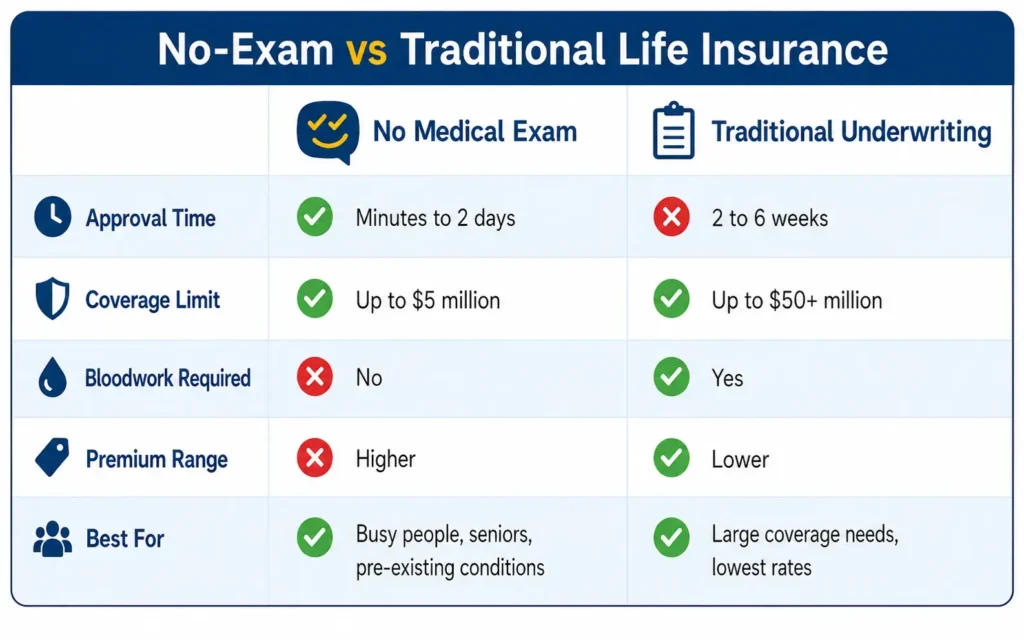
Compared with traditional fully-underwritten policies, these rates run roughly 0–8% higher for accelerated underwriting in the under-50 age bands. The premium difference grows in older bands or when health flags appear, which is when traditional underwriting starts to make better financial sense.
Where No-Exam Coverage Falls Short
Honesty matters here, so the trade-offs deserve a clear paragraph. No-exam policies typically cap coverage lower than traditional ones most carriers max out instant-decision policies at $3 million, while a fully-underwritten policy can go to $10 million or more for high-earning applicants. No-exam premiums are also higher for people who would have qualified as “super-preferred” with a full exam (athletic build, low cholesterol, low blood pressure). If you are confident your bloodwork will come back strong, the savings from a traditional exam can be meaningful sometimes 20% lower over the life of the policy.
How the Application Actually Works
Step 1: Compare quotes from 3–5 carriers
Rates for the exact same coverage vary by 30–50% between carriers because each one weighs risk factors differently. Use a marketplace like our life insurance quote rather than going to a single carrier’s website single-carrier quotes look cheap until you compare them.
Step 2: Complete the health questionnaire honestly
Most applications take 15–25 minutes. Answer every question truthfully every major carrier cross-references your answers against the MIB, prescription databases, and DMV records. A misstatement, even an honest mistake, can void the policy at claim time. The two-year contestability period means insurers can investigate any death claim during the first two years of the policy.
Step 3: Wait for the underwriting decision
With accelerated underwriting, decisions arrive in 5–30 minutes. If approved, you e-sign the policy, pay the first premium, and coverage is in force the same day. If the algorithm cannot make a decision, the carrier may request a phone interview or, in rare cases, route you to traditional underwriting. None of this costs you anything.
Common Pitfalls to Avoid
Three mistakes account for most no-exam application denials and delays. First, applying with the carrier whose rate looks lowest before checking their underwriting niche every carrier has a sweet spot, and applying with the wrong one can produce a decline that follows you on the MIB for seven years. Second, under-reporting prescriptions or past diagnoses. The databases will surface them either way; honesty preserves your approval. Third, applying for too low a coverage amount. “Burial policies” of $25,000 cost roughly $40–$60 per month at age 50, while a $250,000 term policy at the same age costs around $52–$66 per month many people end up buying ten times the coverage for the same money once they see the comparison.
How These Rates Were Verified
Premium figures in this article were pulled from 2026 published rate cards of seven major U.S. life carriers across multiple states, then averaged. Underwriting timelines reflect 2025 LIMRA industry reports on accelerated underwriting outcomes. Individual rates vary by state, health, occupation, and hobby disclosures. QuoteJoy is independent and accepts no commissions in exchange for favorable carrier placement.
Frequently Asked Questions (FAQs)
Slightly, but the gap has narrowed dramatically since 2020. For healthy applicants under 50, accelerated underwriting now costs roughly 0–8% more than a traditional medical exam. For applicants with strong bloodwork potential (athletes, very low cholesterol), traditional exams can still produce 15–20% lower lifetime premiums.
Yes — most major U.S. carriers now offer up to $3 million through accelerated underwriting for healthy applicants under 60. A few extend higher with additional questions. Coverage above $3 million typically still requires a traditional exam.
Usually no. Most carriers approve well-controlled hypertension and statin use through accelerated underwriting at standard rates. The same is true for many controlled conditions. The combination of multiple flags is what typically routes you out of accelerated underwriting.
Most healthy applicants can get a same-day decision through accelerated underwriting in 2026Â without a doctor visit, without bloodwork, and at rates within a few dollars of traditional coverage. Start with our free life insurance quote to compare 8+ carriers in 90 seconds. If you are unsure how much coverage you need, our life insurance coverage walks through the math by age and income. And for parents balancing multiple policies, our term vs whole life comparison helps you decide which structure makes sense.